


Multifamily Parking Pricing Strategy: A Practical Guide


A documented cost floor, segmented inventory, and tiered monthly rates form the foundation of any sound parking pricing strategy for multifamily properties. Set your floor first, then price up by spot quality. Here is where to start today:
Calculate your annualized cost-per-space using the Parking Cost, Pricing and Revenue Calculator (VTPI) and set a minimum rate that covers operating costs.
Segment your inventory into at least three tiers: standard uncovered, covered or reserved, and EV-enabled stalls.
Launch a priced guest-permit pilot before touching resident permit rates. It is lower friction, reveals enforcement gaps, and generates immediate revenue.
Draft a one-page enforcement and communications plan before you announce any price change.
Pro Tip: Joani Schumaker at The Revenue Method recommends treating parking as a managed amenity, not a lease afterthought. The properties that get this right document their cost floor before they ever look at what competitors charge.
Key Takeaways
A documented cost floor, segmented inventory, and tiered rates are the three non-negotiable foundations of a multifamily parking pricing strategy that recovers costs and holds up under resident scrutiny.
Point | Details |
Calculate your cost floor first | Use the VTPI calculator to annualize costs per occupied bay before setting any market-facing rate. |
Segment inventory into tiers | Classify every bay (standard, covered, reserved, EV, visitor) and apply multipliers before publishing rates. |
Pilot guest permits before raising resident rates | Guest permits reveal enforcement gaps and generate revenue with lower resident friction. |
Measure occupancy by zone weekly | Persistent waitlists signal underpricing; sudden occupancy drops after an increase signal overreach. |
The Revenue Method provides advisory support | For portfolio rollouts, EV pricing, or lease language, The Revenue Method offers strategy, pilot design, and staff training. |
Table of Contents
What should a multifamily parking pricing strategy actually achieve?
Good parking pricing does four things: recovers real operating costs, manages demand across limited supply, treats non-drivers fairly, and supports property goals like retention and amenity revenue. Most multifamily programs fail on at least two of those.
The core principle is straightforward. Efficient parking pricing charges users directly, varies with demand, and targets cost recovery. When parking is underpriced or bundled invisibly into rent, non-drivers subsidize drivers, and the property absorbs costs it never recovers. That is not a fairness argument alone; it is a financial one.
A few non-negotiable constraints apply before you set a single rate:
ADA-designated spaces must comply with federal and local accessibility requirements. You cannot surcharge accessible stalls above standard rates. Review ADA parking compliance requirements and confirm your local ordinance before publishing any tier that touches accessible inventory.
Local rent control or fee ordinances may restrict how and when you can introduce or raise parking fees. Consult counsel before rolling out new charges in regulated markets.
Resident experience and renewal risk are real. Parking problems correlate with lower resident satisfaction, higher churn, and worse online reviews. Pricing that feels arbitrary or unfair accelerates complaints. Pricing that feels transparent and consistent tends to get accepted.
What pricing models work for apartment parking?
You have more options than flat monthly permits. The right model depends on your parking ratio, market type, and operational capacity.
Rent-bundled: Parking is included in the base rent. Simple to administer, but it hides costs, subsidizes all drivers equally, and removes a revenue lever. Best fit: very low parking ratios where demand is not a constraint.
Flat monthly permit: One rate, all stalls. Easy to manage, but leaves money on the table when some spots are clearly more desirable.
Tiered permit (standard/covered/reserved): Different rates by spot quality. This is the most common model for properties with mixed inventory and the one that best reflects how residents actually value different bay types.
Bookable or shared permits: Residents buy credits or reserve windows. Works in urban properties with low car ownership and high turnover demand.
Guest hourly or nightly passes: Priced separately from resident permits. Low friction to introduce, and a reliable signal of real demand.
EV energy pass-through plus stall rent: Separates the monthly stall fee from per-kWh energy costs. Prevents cross-subsidy between EV and non-EV residents.
Premium or event pricing: Valet, covered event stalls, or proximity premiums during lease-up. Situational but worth having in your toolkit.
Model | Fairness | Admin burden | Revenue potential | Resident friction |
Rent-bundled | Low | Low | Low | Low |
Flat monthly permit | Medium | Low | Medium | Low |
Tiered permit | High | Medium | High | Medium |
Bookable/shared | High | High | Medium-High | Medium |
Guest passes | High | Medium | Medium | Low |
EV pass-through | High | Medium-High | Medium | Low-Medium |
How do you set parking rates from scratch?
This is a four-step process. Work through it in order and document every input.
Calculate your cost floor. Add up annualized maintenance, insurance, lighting, cleaning, gate or access system costs, and amortized capital (resurfacing, striping, structure). Divide by occupied bays, not total bays. Annual per-space costs range from roughly $600 for simple surface lots to $4,000 or more for structured parking. Use the VTPI Parking Cost, Pricing and Revenue Calculator to validate your math before you set a single rate.
Collect market comps. Survey three to five comparable properties nearby. Note what each comp includes (covered vs. uncovered, gated, EV-ready) and what it charges. Also check nearby public garages and street parking rules. Your rates do not need to match comps, but you need to know where you sit.
Segment inventory and assign multipliers. Classify every bay: standard uncovered, covered or deck, reserved, compact or tandem, EV-enabled, and visitor or transient. Then apply spreads. A reasonable starting point: reserved at 1.3–1.5× standard; compact or tandem at 0.7–0.85× standard; EV-enabled stall rent at 1.2–1.4× standard (energy billed separately).
Set occupancy targets and price to them. Aim for 85–95% fill on premium tiers. A persistent waitlist on reserved stalls is a clear signal your price is too low. Price so that high-demand tiers carry a short waitlist rather than a universal shortage.
Worked example (100-unit property, surface lot, 80 occupied bays):
With a $37.50 floor, a standard uncovered stall might price at $75–$90/month (covering costs plus a demand margin), a covered reserved stall at $110–$135/month (1.4× standard), and a compact stall at $60–$70/month (0.8× standard).
Pro Tip: Run your cost-floor math before you look at comps. Operators who start with comps often set rates that look competitive but still lose money on parking operations.
How do you operationalize parking pricing without it falling apart?
Pricing decisions mean nothing without a working program behind them. Transparent rules and consistent enforcement are what turn a pricing model into resident acceptance.
Payment and billing:
Add a parking addendum to the lease rather than burying fees in base rent.
Bill monthly permits as a separate line item for clarity.
For EV stalls, bill stall rent monthly and energy costs as a pass-through on a separate invoice or statement.
Enforcement workflow:
Issue written warnings for first violations, then escalate to fines or tow authorization.
Keep an audit trail: date, bay number, vehicle description, action taken.
Enforce consistently. Selective enforcement destroys resident trust faster than a price increase.
Lease language guidance:
Your parking addendum should cover: permit type and assigned bay, monthly fee and billing cycle, guest permit rules and fees, enforcement steps and cure periods, and the notice period required for rate changes (check your local ordinance; 30 days is common but not universal).
Run all lease language by legal counsel before distribution.
90-day launch checklist:
Finalize cost floor and tier rates.
Update or draft parking addendum; have counsel review.
Notify residents in writing with at least the required local notice period.
Install or update signage. Review parking lot striping standards to confirm bay markings are clear and compliant.
Train staff on enforcement procedures and resident FAQ responses.
Launch priced guest-permit pilot in week one.
Review complaint volume and guest permit sales at 30 days.
How do you price EV charging without creating billing headaches?
Separate the stall from the energy. This is the single most important structural decision in EV parking pricing.
Monthly stall rent covers the reserved bay, access, and any infrastructure cost amortization.
Energy pass-through bills residents for actual kWh consumed, either via a metered sub-account or a flat energy fee based on average consumption.
Idle fees protect charger availability. Charge a per-hour fee after a session ends but the vehicle remains plugged in. Post the policy clearly on signage at the stall.
Booking windows work well in properties with shared EV stalls. Residents reserve time blocks, and the system prevents one resident from monopolizing a charger.
For other premium amenities, covered stalls bundled with a valet or event service can carry a short-term premium during lease up.
Pro Tip: Meter every EV stall from day one, even if you start with a flat energy fee. Retroactively installing metering after residents are used to flat billing is a harder conversation than setting expectations upfront.
What should you measure, and how often?
Measuring occupancy by zone and hour is the foundation of any parking pricing review. Without it, you are guessing.
Core KPIs:
Occupancy by zone and by hour (separate transient from long-stay)
Revenue per bay per month
Waitlist length by tier
Guest permit sales volume
Enforcement incidence rate
Complaint volume by category
Revenue vs. cost floor
Review cadence:
Weekly: check enforcement incidents and guest permit sales. Flag anomalies.
Monthly: review occupancy by tier, revenue per bay, and complaint trends. Compare to prior month.
Quarterly: make pricing decisions. Raise, hold, or roll back based on occupancy signals and waitlist data. Align this with your broader revenue management review cadence.
Reading the signals:
Persistent waitlist on a tier for 60+ days: raise that tier’s price by 10–15% or reassign inventory.
Occupancy drops more than 10 points after a price increase: roll back or offer a temporary promotional rate while you gather more data.
Guest permit complaints spike: review enforcement consistency before raising guest rates further.
Ready-to-adapt pricing tiers, lease language, and resident notices
These templates are starting points. Have your legal counsel review them for local compliance before use.
Sample pricing tiers:
Standard uncovered: $75–$100/month. Unreserved, surface lot, first-come basis. Rationale: covers cost floor plus a demand margin.
Covered or reserved: $110–$150/month. Assigned bay, covered or premium location. Rationale: 1.3–1.5× standard per tiered pricing guidance.
EV-enabled stall: $95–$130/month stall rent plus energy pass-through. Rationale: infrastructure premium separate from consumption cost.
Sample lease addendum language:
Resident announcement email (template):
Common resident objections and responses:
“I’ve always had free parking.” Parking has always had a cost; it was previously included in your rent. Separating it makes the fee visible and fair to residents who don’t use it.
“The rate went up too fast.” We gave [X] days’ notice per our lease terms and local requirements. Here is how the rate was calculated.
What most parking programs get wrong
Most parking programs fail not because the pricing is wrong, but because the execution is. Poor enforcement, hidden costs that never get recovered, and a failure to segment inventory are the three most consistent problems I see across multifamily portfolios.
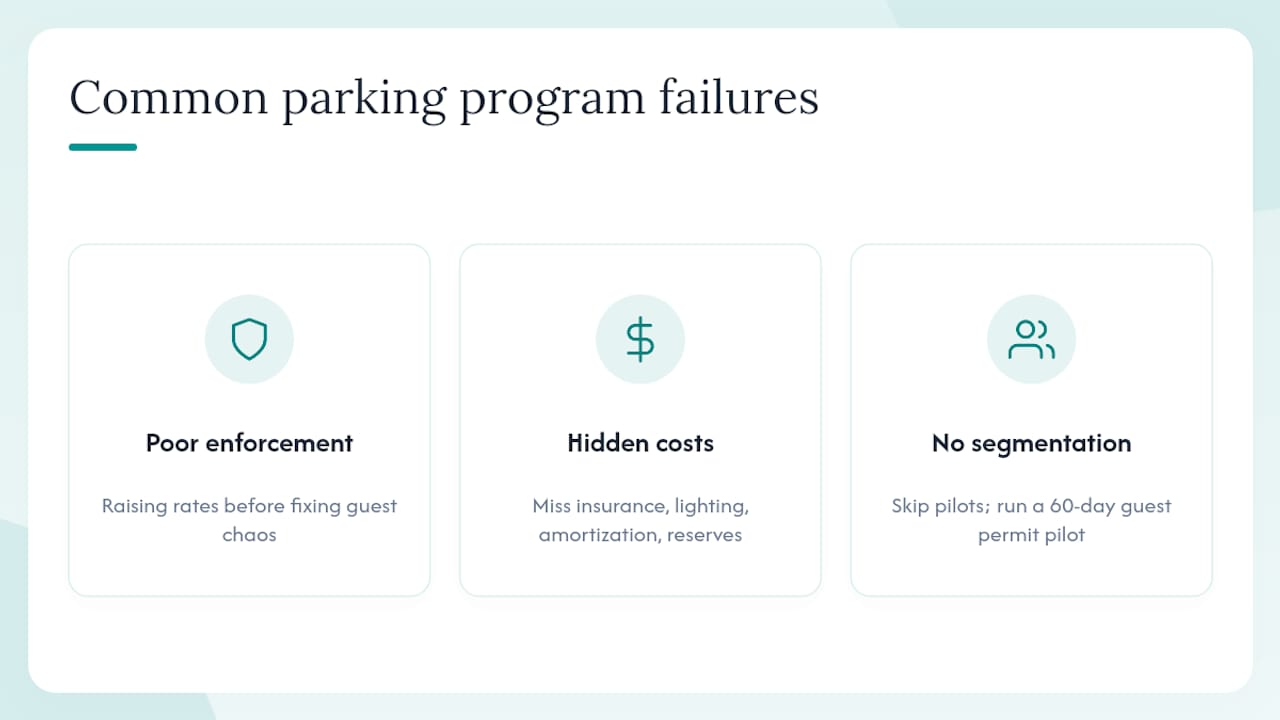
Operators raise rates without fixing guest chaos first. Residents who can’t find a spot because unregistered guests are occupying resident bays will complain about the price increase, not the enforcement gap. The sequence matters: fix the operational problem, then price it.
Undercounting real costs is equally common. Operators look at what they pay a vendor for monthly maintenance and call that the cost floor. They miss insurance allocations, lighting, gate system amortization, and the capital reserve for resurfacing. The VTPI calculator forces you to account for all of it.
The third mistake is skipping the pilot. Launching portfolio-wide price changes without a single-building or single-tier test is how you generate a wave of complaints you can’t diagnose. A 60-day guest permit pilot on one property tells you more about resident tolerance and enforcement gaps than any amount of planning.
Keep resident trust by communicating the rationale plainly. Residents accept price changes when they understand what they are paying for. They resist when it feels arbitrary.
When advisory support makes sense for your parking program
If you are rolling out parking pricing across a portfolio, managing a complex EV infrastructure buildout, or dealing with disputed enforcement and resident escalations, that is when outside advisory support pays for itself.

The Revenue Method works with multifamily owners, operators, and asset managers on exactly these projects: building the cost floor, designing tier structures, drafting lease addendum language, training site teams, and running pilots that generate real data before a portfolio-wide rollout. The work is strategy and implementation, not software sales.
If you need a fast answer on a specific parking pricing question, a short paid advisory conversation through The Revenue Method’s billing-you-for-this-conversation product is a practical starting point. For a full parking pricing audit or portfolio rollout, reach out directly to discuss an engagement.
Sources
All lease language and notice period templates in this article are general guidance only. Review with qualified legal counsel and confirm compliance with your local ordinances before use.
Recommended


Comments