


Real Estate Asset Management Fees: Owner's Guide


Asset-level real estate asset management fees for U.S. multifamily owners typically range from 0.35% to 0.75% of asset cost or value annually, billed monthly on a pro rata basis. This range is supported by SEC-filed agreements and regulatory exhibits. That range comes directly from SEC-filed advisor agreements, not from fund-level sponsor economics, which is a different subject entirely. This guide is about what you pay at the asset level for day-to-day oversight, pricing strategy, and revenue advisory, not what a private equity sponsor charges on committed capital.
Short version:
Asset management fees at the property level typically range around a few tenths of a percent up to just under one percent of cost basis or asset value, billed monthly (as a monthly fraction of the annual rate)
Acquisition and disposition fees commonly run a few percent of contract price, paid at closing
The most important negotiation lever is to ask for the fee basis, any caps, and a complete reimbursables list before you sign anything
When you review a fee schedule, ask three questions up front: What is the basis (cost, value, or flat)? Are there caps? What expenses get reimbursed on top? Those three answers tell you most of what you need to know. The Revenue Method works with multifamily owners and operators to review exactly these structures before and during advisory engagements.
Table of Contents
What real estate asset management fees actually pay for
The phrase “asset management fee” covers a lot of ground, and that ambiguity is where owners lose money. At the asset level, the fee should pay for active oversight: pricing strategy, lease-up guidance, renewal strategy, weekly performance review, billing oversight, reporting, amenity pricing reviews, and implementation support for revenue management systems. If a fee schedule does not specify those deliverables, you are paying for a title, not a service.
The most common calculation bases you will see in U.S. agreements are:
Percentage of adjusted cost basis — (most common in SEC-filed agreements): the annual rate divided by 12 and applied monthly to the property’s cost of acquisition plus capital improvements
One SEC-filed advisor agreement defines the asset management fee as one-twelfth of 0.50% of total asset value monthly, with an option for the manager to charge up to an additional one-twelfth of 1.0% for multifamily investments when no separate property management fee is paid. That layering provision is worth flagging: it means the fee can effectively double if property management is bundled in.
Asset-level fees are distinct from property management fees (typically 4%–10% of collected rents, covering on-site operations) and from fund-level sponsor fees (often 1%–2% of committed capital across a portfolio). Conflating them is the most common mistake owners make when reading a fee schedule.
Common fee types you will see in asset-level agreements
Most U.S. asset-level agreements include some combination of the following components. Knowing the typical range for each helps you spot outliers fast.
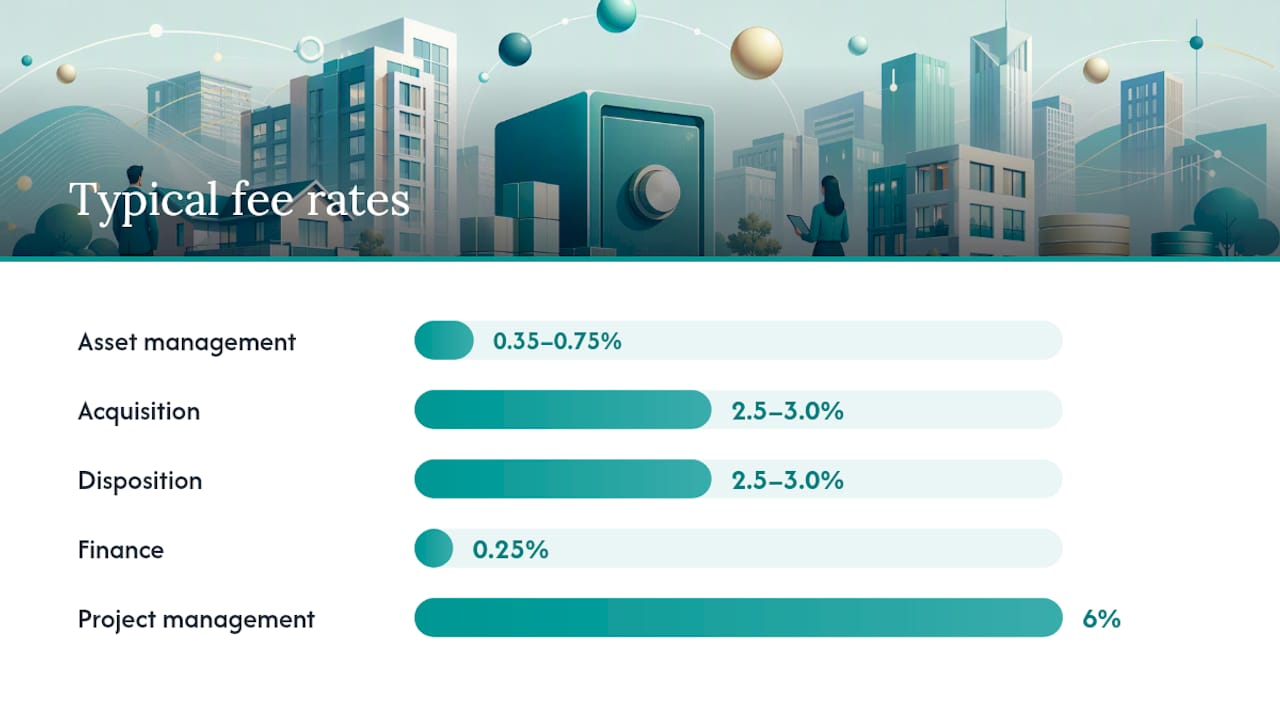
Asset management fee — 0.35%–0.75% of cost or value annually, billed monthly (SEC-filed agreements show 0.35%–0.75% as the typical range; see referenced exhibits for full clauses)
Acquisition fee: 2.5%–3.0% of contract price, paid at closing; some filings show 3.0%
Incentive / performance fee: triggered above a return hurdle, often 7% cumulative; one KBS filing sets the asset management fee at one-twelfth of 0.75% of cost with a performance fee above that threshold
Pro Tip: Watch for fee layering. An agreement that charges both an asset management fee and a property management fee through the same advisor or affiliate can result in double-billing for oversight functions that overlap. Ask for a clear scope-of-work breakdown for each fee line.
Industry commentary consistently stresses transparency and alignment between advisor fees and owner interests. A fee schedule that is hard to read is usually hard to negotiate, too.
How fees are billed and what to watch for in contracts
Monthly pro rata billing is standard for asset management fees: take the annual rate, divide by 12, apply to the basis. Acquisition and disposition fees are lump-sum payments at closing. Finance fees are typically paid at loan funding. Project management fees are often billed in draws tied to construction milestones.
Waivable fees are common in SEC-filed manager agreements. The manager usually reserves discretion to waive fees but must notify the company when waivers occur. Without objective waiver triggers or caps written into the agreement, that discretion is effectively meaningless to the owner. Demand specific conditions under which fees are waived, not just a general reservation of the right to do so.
Common contract traps to flag before signing:
Ambiguous reimbursables — broad language covering “personnel and administrative costs” can include overhead you never agreed to fund; SEC filings show monthly reimbursement mechanics that can add meaningfully to total cost
Pro Tip: Negotiate a cap on reimbursable expenses as a dollar amount or a percentage of the asset management fee. An uncapped reimbursables clause is an open-ended cost commitment.
Benchmark ranges and worked examples on real assets
Fee Type | Typical Range | Basis | Timing |
Asset management fee | 0.35%–0.75% annually | Cost or value | Monthly pro rata |
Acquisition fee | 2.5%–3.0% | Contract price | At closing |
Disposition fee | 2.5%–3.0% | Contract price | At closing |
Finance fee | 0.25% | Loan amount | At funding |
Project management fee | 6% | Project cost | Milestone draws |
Performance fee | Negotiated | Returns above hurdle | Upon threshold |
Worked example: $10M multifamily asset
At an annual rate around half a percent, the monthly asset management fee on a $10 million asset calculates to several thousand dollars per month, with acquisition and disposition fees adding hundreds of thousands at closing. On larger assets, the fees scale accordingly and project management fees can add substantial amounts. Across multi-year hold periods and value-add cycles, total fees can accumulate into the millions before reimbursables.
A 0.25% change in the annual asset management rate on a $50M asset shifts annual cost by $125,000. Over a five-year hold, that is $625,000 in additional or recovered cash flow, which is a material impact on projected returns.
How to evaluate a fee schedule and negotiate effectively
Work through this checklist before you sign any advisory or asset management agreement:
Confirm the fee basis in writing: cost, current value, or flat amount
Verify the monthly pro rata calculation and request a sample invoice
Identify every reimbursable expense category and request a dollar cap or percentage ceiling
Confirm acquisition and disposition fee rates and whether they apply to refinances
Check whether the performance fee hurdle is cumulative or annual, and how it resets
Ask for explicit waiver conditions, not just a general waiver right
Request a conflict-of-interest disclosure covering affiliated vendors and co-investments
Confirm reporting frequency and format (weekly, monthly, quarterly)
Verify whether the advisor carries errors-and-omissions insurance
Ask what happens to fees during a lease-up period when the asset is not yet stabilized
Consulting pricing guidance recommends anchoring advisory fees to value created, using a 5%–15% rule of thumb as a reasonableness check. If an advisor cannot articulate the value their fee represents relative to your asset’s performance, that is a red flag.
Survey data on consulting fee structures shows project-based and retainer models are the most common structures for advisory engagements. A short pilot project or fee-review audit is a reasonable starting point before committing to a longer retainer.
When to hire a revenue management advisor and how The Revenue Method works
Hire an advisor when you face one or more of these conditions: a lease-up that is running behind pro forma, renewal pressure against a strong comp set, portfolio underperformance you cannot diagnose internally, or no internal bandwidth to run a weekly pricing cadence. Bringing in revenue management consulting is faster and lower-overhead than hiring full-time staff for immediate pricing and lease-up needs.

Engagement Type | Typical Structure | Expected Outcome |
Fee review audit | Project-based, one-time | Clear picture of fee load, red flags, and negotiation levers |
Retainer advisory | Monthly flat fee | Weekly cadence, pricing oversight, reporting, renewals guidance |
Lease-up support | Project or milestone-based | Accelerated absorption, pricing guardrails, leasing strategy |
Implementation support | Project-based | Clean system setup, data integrity, team training |
Amenity pricing review | Project-based | Identified revenue gaps in amenity pricing and premium structure |
The Revenue Method engages as an independent advisor, not tied to any software vendor. In the first 30–60 days of an engagement, you should expect a baseline assessment of your current fee structure and revenue management setup, a pricing and lease-expiration review, and a clear weekly cadence for ongoing oversight. Joani Schumaker leads every engagement directly.
Key Takeaways
Asset-level real estate asset management fees typically run 0.35%–0.75% annually on cost or value, and the reimbursables clause is where most owners lose the most ground.
Point | Details |
Fee basis matters most | Always confirm whether the rate applies to cost, current value, or a flat amount before comparing quotes. |
Reimbursables are the hidden cost | Cap reimbursable expenses by dollar amount or as a percentage of the management fee to control total cost. |
Transaction fees add up fast | Acquisition and disposition fees at 2.5%–3.0% can exceed $600,000 on a $10M buy-hold-sell cycle. |
Waiver clauses need teeth | Demand specific, objective waiver triggers in writing, not just a general manager discretion clause. |
The Revenue Method | Provides independent fee-review audits, retainer advisory, and lease-up support for multifamily owners and operators. |
The part of fee reviews most owners skip
Most owners focus on the headline rate and miss the reimbursables. I have reviewed agreements where the stated asset management fee was set at 0.50%, within the SEC-benchmarked range of 0.35%–0.75%, but the reimbursables clause added another 0.30%–0.40% in effective cost once personnel and overhead were factored in. The fee schedule is the starting line, not the finish line. Clean data, a weekly review cadence, and human oversight of pricing decisions are what actually protect your returns. Software does not do that on its own. If you have not run a line-by-line review of your current advisory agreement, that is the first practical step worth taking.
The Revenue Method can review your fee structure
If your current advisory agreement has not been reviewed against current U.S. benchmarks, you may be paying more than the market rate without realizing it. The Revenue Method offers three direct paths forward: a one-time fee review audit that maps your current cost structure against filed benchmarks and flags negotiation levers; a monthly retainer advisory engagement covering pricing oversight, renewals guidance, and weekly cadence; and lease-up support for assets needing faster absorption and clearer pricing guardrails.

Each engagement is scoped to your asset, not a templated package. No software vendor ties, no conflicting interests. Start with a single advisory session to review your fee schedule and identify where you have room to negotiate, or go directly to the full services page to scope a retainer or project engagement.
Useful sources and how to use them
This article provides general information about U.S. asset-level fee structures and is not legal or financial advice. Confirm current terms and obligations with qualified legal counsel before executing any advisory or management agreement.
Recommended


Comments