


Real Estate Portfolios for Investors: Practical Starter Guide


A resilient, beginner-ready real estate portfolio combines direct property ownership with at least one passive vehicle, such as a REIT or syndication, aligned to a written income or appreciation goal and reviewed on a set cadence. Before you read further, lock in three actions:
Set a written goal. Cash flow target, appreciation horizon, or both. Vague goals produce vague portfolios.
Decide your initial allocation. What percentage of your investable assets goes into real estate? Start there, not with a specific property.
Establish a review cadence. Weekly for active properties, monthly for financials, quarterly for strategy. This single habit separates investors who grow from those who stagnate.
The sections below walk through every major decision, from asset selection and financing to metrics, tax basics, and exit planning.
Table of Contents
What do beginners need to know about real estate portfolios?
How do you build a real estate portfolio from your first purchase through year one?
How should you diversify a real estate portfolio without overcomplicating it?
What financing and tax basics affect your portfolio choices?
What are the real pros and cons of building a property portfolio?
What do sample allocations and common rules of thumb look like in practice?
What do beginners need to know about real estate portfolios?
A few things most explainers skip:
Cash flow and appreciation rarely peak at the same time. Properties that generate strong monthly income often appreciate more slowly. Know which one you need first.
Liquidity is the hidden cost. Selling a rental property takes weeks to months. REITs trade daily. Syndications lock capital for three to seven years. Match the vehicle to your liquidity tolerance before you commit.
Management intensity scales with asset type. A single-family rental demands your weekends. A REIT demands nothing but a brokerage account. Most investors underestimate how much active management affects their actual returns.
Direct ownership suits investors who want control, tax depreciation, and the ability to force appreciation through improvements. Passive vehicles suit investors who want exposure without operational responsibility.
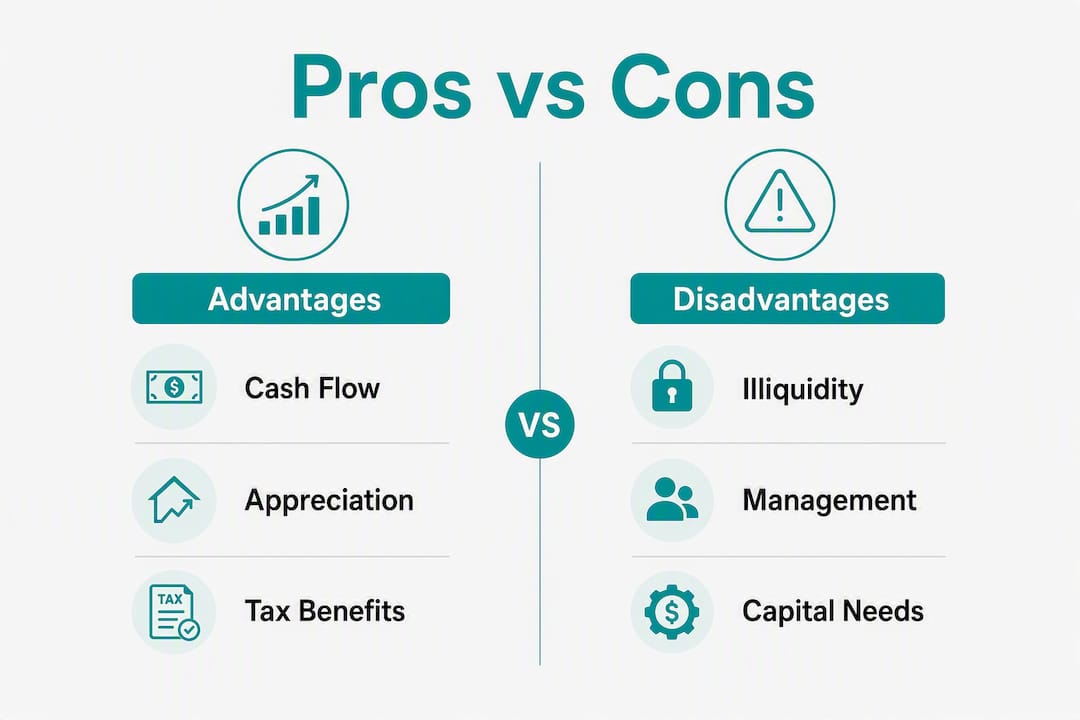
Pros at a glance: steady income potential, long-term appreciation, tax advantages through depreciation, and a natural hedge against inflation.
Cons at a glance: illiquidity, management burden, concentration risk, and capital-intensive entry points.
What is a real estate portfolio and what can it do for you?
A real estate portfolio is your collection of real estate investments, held directly or indirectly, managed together toward a defined financial objective. Direct holdings include properties you own outright or with a mortgage. Indirect holdings include REITs, syndications, and real estate funds that give you exposure without the deed.
Most investors build a portfolio for one or more of these reasons:
Cash flow: monthly income after expenses and debt service
Appreciation: long-term increase in property value
Tax efficiency: depreciation deductions, 1031 exchanges, and passive loss rules
Inflation hedge: rents and property values historically move with inflation
Diversification: real estate often moves independently of stocks and bonds
The goal you choose shapes every decision that follows. A starter investor prioritizing cash flow will build differently than a growth-oriented investor targeting appreciation in high-demand markets. An income-focused retiree will lean heavily on stabilized rentals and REITs. Getting that goal in writing before you look at a single property is not optional.

What asset types belong in a property portfolio?
Different asset types serve different objectives, and each carries a distinct management load and capital requirement. The table below gives you a quick read on each.
Asset Type | Primary Objective | Upfront Capital | Liquidity | Management Intensity | Best For |
Single-family rental | Cash flow + appreciation | Low–moderate | Low | High (active) | Solo landlords, first-time investors |
Small multifamily (2–4 units) | Cash flow | Moderate | Low | High (active) | Owner-occupants, early portfolio builders |
Larger multifamily (5+ units) | Cash flow + scale | High | Low | Medium–high | Experienced operators, syndicators |
Commercial (office/retail/industrial) | Appreciation + income | High | Low | Medium | Accredited investors, experienced operators |
Vacation / short-term rental | Income (seasonal) | Moderate | Low | Very high (active) | Hands-on operators in tourist markets |
House flipping / value-add | Appreciation (short-term) | Moderate | Medium | Very high (active) | Experienced renovators, contractors |
REITs (public) | Income + liquidity | Very low | High | None (passive) | Passive investors, liquidity-focused |
Syndications / private equity | Appreciation + income | Moderate–high | Very low | None (passive) | Accredited investors, long time horizons |
A few notes worth adding:
Single-family rentals are the most common starting point because financing is straightforward and the learning curve is manageable. The trade-off is that one vacancy wipes out 100% of your income from that property.
Small multifamily properties reduce that vacancy risk. A duplex with one vacant unit still generates income from the other.
Vacation rentals can generate strong gross revenue, but operating costs, seasonality, and local regulation changes make them volatile. They require active management or a reliable property manager.
Flipping is not a passive income strategy. It is a business. Treat it as one.
REITs are the fastest way to gain real estate exposure with minimal capital. They issue 1099-DIV forms and do not offer the same depreciation benefits as direct ownership.
Syndications issue K-1s and typically require accredited investor status. They offer passive access to larger deals that most individual investors could not underwrite alone.
How do you build a real estate portfolio from your first purchase through year one?
The roadmap below is designed to be adapted, not followed blindly. Your capital, market, and risk tolerance will shape the specifics.
Write your investment thesis. One paragraph: what you want (cash flow, appreciation, or both), your time horizon, your target geography, and your maximum capital commitment for year one.
Set your allocation target. Decide what percentage of your investable assets belongs in real estate. Most financial planners suggest keeping real estate below 30–40% of total net worth for diversification, though this varies by individual circumstance.
Learn the core underwriting metrics. Before you make an offer, you need to understand net operating income (NOI), cap rate, and cash-on-cash return. These are not optional. They are the language of real estate investing.
Run rent comps and expense estimates. Pull comparable rents from local listings, property management reports, and county assessor data. Build a conservative expense model: vacancy at 8–10%, maintenance reserves, insurance, taxes, and management fees if applicable.
Secure financing pre-approval. Know your borrowing capacity before you shop. Conventional loans typically require 15–25% down for investment properties. Portfolio loans and commercial loans have different underwriting criteria.
Conduct thorough due diligence. Inspection, title search, lease review (if tenant-occupied), zoning confirmation, and insurance quote. Never skip the inspection to win a deal.
Close and stabilize. Address deferred maintenance in the first 30–60 days. Get leases in place or renew existing ones. Set up your accounting system from day one.
Establish your review cadence. Weekly: occupancy and rent collection. Monthly: NOI, cash flow, and expense tracking. Quarterly: portfolio strategy and rebalancing decisions.
Sample first-year timeline:
Months 1–2: Underwriting, financing, and offer
Month 3: Due diligence and closing
Months 4–5: Stabilization, lease-up, and initial capital improvements
Months 6–12: Steady-state operations, monthly financial reviews, and preparation for next acquisition
Pro Tip: Set up a dedicated bank account for each property from day one. Commingling personal and property finances is one of the most common and costly mistakes new investors make. Clean books make tax time faster and portfolio reviews more accurate.
How should you diversify a real estate portfolio without overcomplicating it?
True diversification reduces correlated risk, not just property count. Owning five single-family rentals in the same city, all rented to workers in the same industry, is not a diversified portfolio. If that industry contracts, all five properties face the same headwind simultaneously.
Four practical levers to pull:
Geography: Target at least two distinct markets with different economic drivers. A coastal tech-market property and a Midwest manufacturing-market property respond differently to national economic shifts.
Property type: Mix residential and commercial, or single-family and multifamily, to reduce exposure to any single tenant demographic or regulatory environment.
Tenant profile: Aim for at least two distinct tenant demographic profiles across your portfolio. Workforce housing and luxury rentals rarely face the same demand pressures at the same time.
Vehicle: Blend direct ownership with REITs or syndications. REITs add liquidity; syndications add access to asset classes and deal sizes beyond your individual capital.
Institutional investors typically span three to five asset classes and balance core (stable, income-producing) assets against opportunistic (higher-risk, higher-return) positions. Individual investors can apply a simplified version of this thinking.
Starting moves for a small portfolio (1–3 properties):
Add a REIT position to your brokerage account to gain exposure to commercial or industrial real estate without a second mortgage.
Target your second direct property in a different market or property type than your first.
Starting moves for a mid-sized portfolio (4–10 properties):
Evaluate a syndication investment to access a larger asset class (multifamily, industrial) passively.
Review tenant demographics across all properties and identify any single-industry concentration.
Which KPIs should you track, and how often?
Core performance metrics for any property portfolio include NOI, cap rate, cash-on-cash return, and occupancy. Each one tells you something different, and together they give you a complete picture of asset health.

KPI | How to Calculate | Why It Matters | Alert Threshold |
Net Operating Income (NOI) | Gross income minus operating expenses (before debt service) | Measures property profitability independent of financing | Declining NOI two months in a row |
Cap Rate | NOI ÷ current property value | Benchmarks value relative to income; useful for acquisition decisions | Below market average for your asset class |
Cash-on-Cash Return | Annual pre-tax cash flow ÷ total cash invested | Measures actual return on your out-of-pocket capital | Below your target return threshold |
Occupancy Rate | Occupied units ÷ total units × 100 | Tracks demand and leasing health | Below 90% for stabilized assets |
Effective Rent | Actual rent collected ÷ total leasable units | Accounts for concessions and vacancies | Declining trend over 60 days |
Lease Expiration Schedule | Percentage of leases expiring per month | Prevents revenue cliffs from clustered expirations | More than 20% expiring in any single month |
Debt Service Coverage Ratio (DSCR) | NOI ÷ total debt service | Measures ability to cover loan payments from property income | Below 1.20 |
Expense Ratio | Total operating expenses ÷ gross income | Flags cost creep before it erodes cash flow | Above 50% for residential; varies for commercial |
Recommended review cadence:
Weekly: Rent collection status, occupancy, and any maintenance flags
Monthly: NOI, cash flow statement, expense review, and lease expiration check
Quarterly: Cap rate benchmarking, portfolio rebalancing decisions, and financing review
Failing to monitor occupancy, NOI, and lease expirations on a regular schedule leads to poorer long-term portfolio growth. This is the most common operational gap among investors who plateau early.
Pro Tip: Before you trust any metric, audit the data behind it. A clean data foundation is what makes your KPIs meaningful. Garbage in, garbage out applies to real estate just as much as it does to any other business.
What financing and tax basics affect your portfolio choices?
Financing shapes your returns before a single tenant pays rent. Getting it wrong costs more than most investors realize.
Common financing options:
Conventional mortgages: Best for 1–4 unit residential properties. Typically require 15–25% down for investment properties. Fixed-rate options provide payment predictability.
Portfolio loans: Held by the lender rather than sold to Fannie Mae or Freddie Mac. More flexible underwriting, useful for investors with multiple properties or non-standard income.
Commercial loans: Required for 5+ unit properties. Underwritten on property income (DSCR) rather than personal income. Shorter amortization periods are common.
Bridge loans: Short-term financing for value-add or transitional properties. Higher rates, but useful when a property is not yet stabilized enough for permanent financing.
HELOCs: Home equity lines of credit on existing properties can fund down payments on new acquisitions. Use carefully; they add leverage to your primary residence.
Leverage amplifies both gains and losses. A property purchased with 25% down and financed at a reasonable rate can produce a strong cash-on-cash return even if the cap rate looks modest. But if rents fall or vacancies spike, that same leverage accelerates losses. The right leverage level depends on your cash reserves, your market, and your risk tolerance.
Tax considerations that materially affect portfolio construction:
Depreciation: The IRS allows residential rental property to be depreciated over 27.5 years. This non-cash deduction often offsets taxable rental income, reducing your current-year tax bill.
1031 exchange: Selling one investment property and reinvesting the proceeds into a like-kind property within IRS-specified timelines defers capital gains tax. This is one of the most powerful wealth-building tools in real estate, but the rules are strict and the timelines are tight.
Passive activity rules: Rental income is generally classified as passive. Passive losses can only offset passive income unless you qualify as a real estate professional under IRS rules.
Tax reporting by vehicle: Direct property generates Schedule E income; REITs issue 1099-DIV forms; syndications typically issue K-1s. Each has different implications for your tax return and your accountant’s workload.
Work with a CPA who specializes in real estate before you close your first deal. The tax structure you choose at acquisition affects every year you hold the property.
This article provides general information, not tax or legal advice. Confirm current rules with a qualified tax professional or the IRS directly.
What are the real pros and cons of building a property portfolio?
Advantage | Disadvantage | Mitigation Tactic |
Steady cash flow from rents | Illiquidity — selling takes time | Keep a REIT sleeve in your brokerage for liquid real estate exposure |
Long-term appreciation | Management burden — active properties demand time | Hire a property manager or shift toward passive vehicles |
Depreciation and tax benefits | Concentration risk — too much in one market or type | Diversify by geography, property type, and vehicle |
Inflation hedge | Capital-intensive entry | Start with small multifamily or a REIT position; scale into direct ownership |
Leverage amplifies returns | Leverage amplifies losses | Maintain cash reserves equal to 6 months of expenses per property |
Tenant demand is relatively stable | Regulatory and legal exposure | Conduct zoning and landlord-tenant law reviews before acquisition |
Real estate rewards patience. Most investors who struggle do so because they underestimate the time horizon required or overestimate their capacity for active management. If you are not prepared to hold a property through a down market, direct ownership may not be the right vehicle for your current situation.
Pro Tip: Before you buy your second property, honestly assess how the first one is running. If you are already stretched on time or cash, adding another active property compounds the problem. A syndication or REIT position might be the smarter next move.
What do sample allocations and common rules of thumb look like in practice?
Four sample allocations, mapped to investor profiles:
Common rules of thumb, and when to trust them:
The 1% rule: — Monthly rent should equal at least 1% of the purchase price. Useful as a quick filter, but it breaks down in high-cost markets where properties rarely hit this threshold yet still perform well.
On net worth allocation: most financial planners suggest keeping real estate below 30–40% of total investable assets to avoid concentration risk, though investors with deep operational expertise and strong cash reserves often hold more. The right number depends on your income stability, liquidity needs, and how actively you can manage the portfolio.
Mixing debt and equity positions across your portfolio changes your overall risk and return profile. Debt investments (like mortgage notes or debt-focused syndications) pay interest with limited upside. Equity investments participate in appreciation. Both have a place depending on where you are in your investing cycle.
What mistakes do investors make, and how do you avoid them?
Pre-purchase checklist:
Pull rent comps from at least three comparable properties in the same submarket.
Review all existing leases for expiration dates, rent levels, and any unusual terms.
Get a full inspection report, including roof, HVAC, plumbing, and electrical.
Confirm zoning and any local short-term rental or landlord-tenant regulations.
Get an insurance quote before closing, not after.
Verify the lease expiration schedule. Clustered expirations create revenue cliffs.
Confirm the title is clear and there are no outstanding liens or code violations.
Model three scenarios: base case, 10% rent decline, and 15% vacancy increase. If the deal only works in the best case, walk away.
Common pitfalls:
Over-leveraging: Taking on too much debt relative to cash flow leaves no margin for vacancy or unexpected repairs. Maintain a DSCR above 1.20 at minimum.
Ignoring tenant demographics: A property full of tenants in a single employer or industry is a concentration risk hiding in plain sight.
Skipping the review cadence: Investors who do not monitor occupancy, NOI, and lease expirations regularly consistently underperform those who do. Set the calendar reminders before you close.
Poor data hygiene: Tracking expenses in a spreadsheet that nobody updates is not a system. Use property management software or a dedicated accounting tool and keep it current.
Chasing yield without underwriting risk: A 10% cap rate in a declining market is not a bargain. Understand why the yield is high before you celebrate it.
Red flags that justify walking away:
Seller refuses to provide rent rolls or historical financials
Deferred maintenance that exceeds your renovation budget
Lease expirations clustered within 60 days of closing
Zoning or permitting issues that are unresolved
Insurance quotes significantly above market due to property condition or claims history
What should your next steps be after reading this guide?
Building a property portfolio is not complicated, but it does require discipline. The investors who succeed are not necessarily the ones with the most capital. They are the ones who set clear goals, underwrite carefully, and review their portfolio like a business.
Three prioritized next steps:
Lock your goal in writing. Cash flow target, appreciation horizon, allocation percentage. One paragraph. Do it today.
Run your first underwriting model. Pick a property in your target market and model it using NOI, cap rate, and cash-on-cash return. Even if you do not buy it, the exercise builds the muscle.
Set your review cadence. Put the weekly, monthly, and quarterly reviews on your calendar now. The cadence is the system. The system is what makes the portfolio perform.
If you are building or managing a multifamily portfolio and want advisory support on pricing strategy, lease expiration management, or revenue management setup, The Revenue Method works directly with apartment owners, operators, and asset managers to improve portfolio performance without vendor bias.
Key Takeaways
A resilient real estate portfolio combines direct ownership with at least one passive vehicle, tracked on a formal review cadence, and aligned to a written investment goal from day one.
Point | Details |
Set goals before buying | A written cash flow or appreciation target shapes every acquisition and allocation decision. |
Diversify across four levers | Geography, property type, tenant profile, and vehicle reduce correlated risk more effectively than property count alone. |
Track eight core KPIs | NOI, cap rate, cash-on-cash, occupancy, effective rent, lease expirations, DSCR, and expense ratio give a complete picture of portfolio health. |
Match financing to the asset | Conventional loans suit 1–4 unit residential; commercial loans underwrite on DSCR for 5+ units; bridge loans serve transitional assets. |
Review cadence is the system | Weekly, monthly, and quarterly reviews prevent stagnation and catch deviations before they compound. |
The review cadence is the part most guides skip
Most real estate investing content focuses on acquisition: how to find deals, how to underwrite, how to close. That part matters. But the investors I see plateau are almost never struggling with acquisition. They are struggling with what comes after.
They buy a property, stabilize it, and then stop looking at it with any real rigor. Months pass. Rents drift below market. Lease expirations cluster. Expenses creep. By the time they notice, they have left a significant amount of income on the table and created a management problem that takes a full quarter to unwind.
The fix is not a better spreadsheet or a fancier software tool. It is a committed review cadence. Weekly for occupancy and collections. Monthly for NOI and cash flow. Quarterly for strategy and rebalancing. That rhythm, applied consistently, is what separates a portfolio that grows from one that just sits there.
For multifamily operators specifically, the lease expiration schedule is one of the most overlooked levers in the entire portfolio. Clustered expirations create revenue cliffs that are entirely preventable with a little forward planning. Most operators only see the problem after it has already hit their NOI.
Software helps. But software is a tool, not the strategy. Clean data, human oversight, and a weekly review habit are what make the numbers mean something. If you are managing a multifamily portfolio and want a structured approach to pricing and lease management, that is exactly what The Revenue Method is built to support.
Useful sources and further reading
The sources below were used to inform this guide and are worth bookmarking for deeper research.
What Is a Real Estate Portfolio and How Does It Work? (LegalClarity) — Clear definitions of core metrics including NOI, cap rate, and cash-on-cash return. A solid reference for investors learning to underwrite their first property.
Real Estate Portfolio Management: A Comprehensive Overview for Investors (BiggerPockets) — Practical guidance on review cadence, occupancy tracking, and the businesslike habits that separate growing portfolios from stagnant ones.
How Do I Build a Diversified Real Estate Portfolio? (Realized1031) — Covers vehicle diversification (direct, REITs, syndications), tax reporting differences (K-1 vs. 1099-DIV), and debt vs. equity positioning. Recommended for investors ready to move beyond single-property ownership.
Real Estate Portfolio Diversification: How Landlords Reduce Risk (VerticalRent) — Explains why true diversification requires analysis of tenant demographics and economic driver correlation, not just property count or geography.
How to Diversify a Real Estate Portfolio Across Asset Classes and Markets (Primior Group) — Institutional framework for asset class and strategy diversification; useful for investors scaling beyond five properties.
How to Build a Diversified Real Estate Portfolio (SmartAsset) — Accessible overview of diversification principles for individual investors, including geographic and risk-profile balancing.
What Is a Real Estate Portfolio? (Chase) — Straightforward primer on portfolio definition and property mix strategy from a lending perspective.
The Revenue Method resources for multifamily operators:
Navigating the Real Estate Data Dilemma — Practical guidance on cleaning portfolio data before trusting your KPIs.
Best Practices for Leasing with Revenue Management — Operational leasing practices tied to weekly review tactics.
ExpirationIQ — Lease expiration analysis tool for multifamily operators managing portfolio-level renewal risk.
Recommended next reads by situation:
Beginner buy-and-hold investor: Start with the LegalClarity and Chase primers, then move to BiggerPockets for operational depth.
Syndication investor: The Realized1031 and Primior Group pieces cover vehicle structure and institutional allocation thinking.
Tax planning focus: Consult the Realized1031 article on K-1 vs. 1099-DIV reporting, then work with a CPA who specializes in real estate before your next acquisition.
Recommended


Comments