


Renewals and Property Management Revenue: 2026 Guide
- Joani Schumaker
- 2 days ago
- 8 min read

Lease renewals are the single most direct lever for property management revenue growth, reducing net operating income losses from turnover costs of $3,525–$5,000 per unit while delivering predictable cash flow that new leases simply cannot match. The role of renewals in property management revenue extends well beyond keeping a unit occupied. A structured renewal program protects your NOI, reduces concession spending, and creates a compounding financial advantage across your entire portfolio.
How do lease renewals impact property management revenue?
Renewals outperform new leases on nearly every financial metric. Retained tenants generate 3–4% annual rent growth compared to just 1% from new lease signings. That gap translates to $5,000–$9,000 more revenue per retained unit annually. For a 100-unit property, the math becomes significant very quickly.
Turnover is the hidden cost most owners underestimate. Each lost renewal triggers vacancy loss, make-ready expenses, leasing commissions, and concession packages. Avoided concessions alone range from $1,400 to $4,200 per renewal event. When you add those savings to the rent growth differential, the financial case for prioritizing renewals over new lease acquisition becomes clear.

The portfolio-level impact is equally compelling. Reducing turnover by just 1% saves approximately $127 per unit annually. On a 300-unit portfolio, that single percentage point improvement adds up to $331,200 in annual savings. That figure does not include the revenue upside from higher rents on renewed leases.
Scenario | Cost or Revenue Impact |
Turnover cost per unit (2026) | $3,525–$5,000 |
Revenue gain per retained unit annually | $5,000–$9,000 |
Avoided concessions per renewal event | $1,400–$4,200 |
Savings from 1% turnover reduction (300 units) | $331,200 |
Month-to-month tenancy adds another layer of financial risk. When a lease expires without renewal, you lose rent predictability and gain exposure to short-notice vacancies. That exposure is a direct threat to your property management income streams and your ability to forecast NOI accurately.
What are effective renewal strategies to maximize revenue?
The most effective renewal strategies share one characteristic: they start early. Outreach beginning 90–120 days before lease expiration gives you time to influence a tenant’s decision before they have already committed to moving. Waiting until 30 days out is rarely effective because the decision is often already made.
Here is a structured renewal cadence that works at scale:
Day 90–120 before expiration: Send a personalized renewal offer with a clear deadline and an early-bird incentive. Use the tenant’s name, unit details, and lease history to make it feel specific, not templated.
Day 60 before expiration: Follow up with a second touchpoint. Include a maintenance update or a community improvement highlight. This reinforces the value of staying.
Day 45 before expiration: Escalate to a phone call or video message. Persistence through multiple follow-ups increases renewal success by 38%. A brief personal video from the property manager outperforms a generic email every time.
Day 30 before expiration: Final offer with a clear deadline. If the tenant has not responded, this is your last structured opportunity before the lease rolls month-to-month.
Pro Tip: Skip rent concessions as your first incentive. Tiered physical upgrades like smart thermostats or kitchen backsplashes cost less than a month of free rent, improve asset value, and shift the tenant’s mindset from “what am I paying” to “what am I getting.” That reframe reduces churn more reliably than a discount.
Maintenance responsiveness is the most underrated renewal driver. Responsive maintenance directly reduces average turnover costs of $4,000–$5,000 per unit by keeping tenants satisfied throughout the lease term, not just at renewal time. Residents who feel heard and well-served are far more likely to sign again. This is the service-to-renewal correlation that many managers overlook when they focus only on the renewal offer itself.
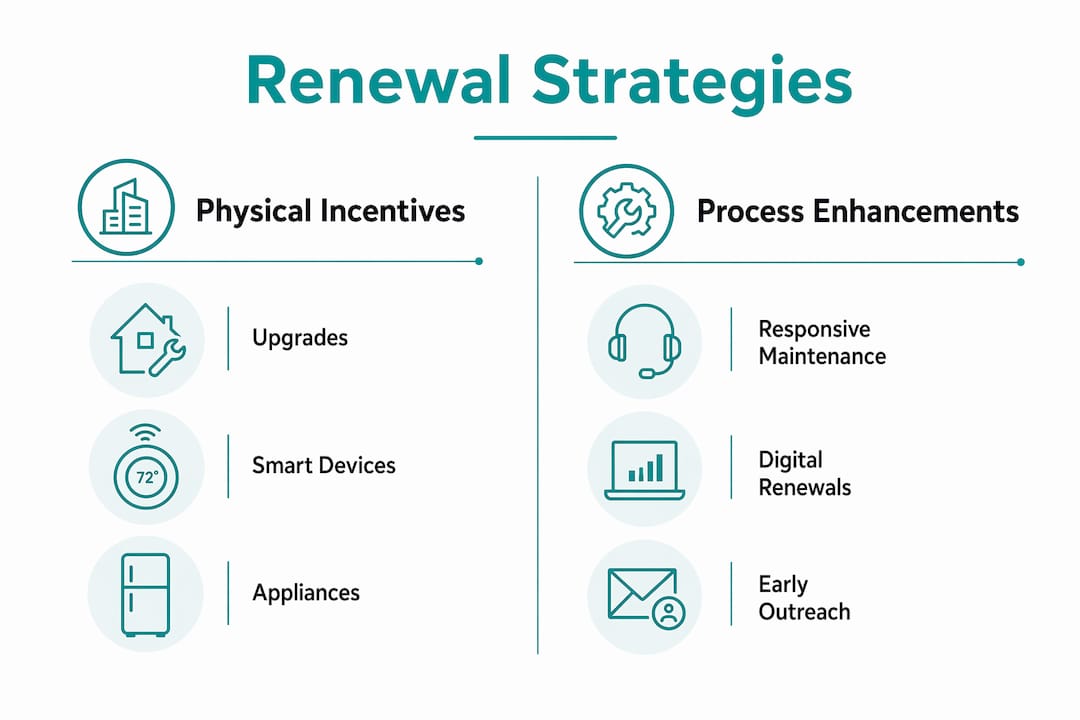
Mobile-first digital renewals also reduce friction significantly. When a tenant can review, sign, and return a lease from their phone in under five minutes, the barrier to renewal drops. Pair that with SMS reminders and you remove the “I forgot to deal with it” excuse that kills otherwise likely renewals.
How do renewal fees fit into property management revenue?
Renewal fees are a legitimate and underused property management income stream. They compensate managers for the administrative work of coordinating renewals, processing paperwork, and managing tenant communication. More importantly, they align manager incentives with owner interests by rewarding proactive lease retention rather than just new lease acquisition.
Typical renewal fees range from $50 to $500 per renewal event. The right number for your market depends on your portfolio size, local norms, and the scope of your renewal coordination process. A fee in the $200–$300 range is common in competitive multifamily markets and rarely triggers tenant pushback when the renewal process itself is smooth and professional.
The portfolio-level revenue from renewal fees is meaningful. A 250-door portfolio with a 70% renewal rate and a $250 fee generates $43,750 annually. That revenue funds renewal coordinators, automation tools, and the infrastructure needed to run a high-performance retention program.
Portfolio Size | Renewal Rate | Fee Per Renewal | Annual Fee Revenue |
100 doors | 70% | $150 | $10,500 |
250 doors | 70% | $250 | $43,750 |
500 doors | 75% | $200 | $75,000 |
Many managers avoid renewal fees out of fear that tenants will push back. That fear is largely unfounded and, more importantly, it subsidizes owner risk at the manager’s expense. Renewal fees protect owner revenue by incentivizing managers to actively pursue renewals and prevent the drift into month-to-month tenancy that exposes owners to sudden vacancy. For guidance on structuring these fees within your management contract, a solid property management contract guide can help you frame the conversation with owners.
Pro Tip: Present renewal fees to owners as a revenue protection mechanism, not an add-on charge. When you frame the fee as the cost of avoiding a $4,000 turnover, the math is obvious. Most owners will agree immediately.
What role does technology play in optimizing lease renewals?
Automation is the difference between a renewal program that works at scale and one that depends entirely on individual manager follow-through. Automated renewal sequences produce 23% higher renewal rates than manual outreach, with top-performing properties reaching 85–92% renewal rates. That is not a marginal improvement. It is a structural advantage.
The operational efficiency gains are equally significant:
Time per renewal drops from 35 minutes to 5 minutes when automated workflows handle scheduling, reminders, and document delivery. That frees managers to focus on high-value tenant conversations rather than administrative follow-up.
65% of renewals get signed before the 60-day mark when automation initiates outreach at the 90–120 day window. Earlier signed renewals mean better lease expiration management and fewer last-minute vacancies.
Preliminary engagement before the formal offer increases renewal probability by 31%. A simple maintenance check-in or community update sent at day 90 warms the tenant before the renewal offer arrives at day 75.
SMS and email sequences, combined with digital signature tools, remove the friction points that kill renewal momentum. A tenant who receives a text with a direct link to their renewal offer and can sign in two taps is far more likely to complete the process than one who receives a paper notice and has to schedule an office visit.
Platforms built for lease expiration management, like ExpirationIQ, give portfolio managers visibility into upcoming expirations, renewal status, and lease concentration risk across multiple properties. That visibility is what separates reactive renewal management from a proactive revenue strategy. For a broader view of how leasing integrates with revenue management, The Revenue Method’s guide on leasing with revenue management covers the full picture.
The role of a property manager in investment performance increasingly depends on their ability to run these technology-driven workflows. Owners evaluating management partners should ask directly: what does your renewal automation look like, and what renewal rate does it produce?
Key takeaways
Renewals are the highest-return revenue activity in multifamily property management, and a structured program combining early outreach, automation, and renewal fees consistently outperforms reactive approaches.
Point | Details |
Turnover cost is the core risk | Each lost renewal costs $3,525–$5,000 per unit, directly reducing NOI. |
Renewals outperform new leases | Retained tenants generate 3–4% annual rent growth versus 1% from new leases. |
Automation lifts renewal rates | Automated sequences produce 23% higher renewal rates, reaching 85–92% at top properties. |
Renewal fees fund retention programs | A 250-door portfolio at 70% renewal and $250 per fee generates $43,750 annually. |
Start outreach at 90–120 days | Early engagement increases renewal probability and reduces last-minute vacancy exposure. |
Renewals are an asset management decision, not a leasing task
I have worked with multifamily operators who treat renewals as the last step in the leasing cycle. They send an offer 30 days out, wait for a response, and then scramble to fill the unit when the tenant declines. That approach treats renewals as paperwork. It is not.
A renewal offer is the report card for the previous 300-plus days of property management. By the time a tenant receives that offer, they have already formed an opinion about whether they want to stay. If maintenance requests went unanswered, if the community felt neglected, or if communication was inconsistent, no renewal incentive will overcome that. The offer is just the final step in a retention process that started the day they moved in.
What I have seen work consistently is treating the renewal program as an asset management lever. That means tracking renewal rates by property and by manager, modeling the NOI impact of each percentage point of improvement, and building renewal performance into how you evaluate your management team. When renewal rates are a KPI with real consequences, behavior changes.
The combination of early outreach, responsive maintenance, tiered incentives, and automation is not complicated. But it requires intention. Most operators I work with have the tools. They just have not connected them into a system. That is where the revenue gets left on the table.
— Joani Schumaker
How the revenue method supports your renewal revenue strategy
If your renewal rates are below 80% or your team is still managing renewals manually, there is measurable revenue sitting uncaptured in your portfolio. The Revenue Method works with multifamily owners and operators to build renewal programs that are data-driven, automated, and aligned with your broader pricing strategy.
ExpirationIQ gives you real-time visibility into lease expirations, renewal status, and concentration risk across your portfolio. Paired with The Revenue Method’s multifamily revenue management consulting, it becomes a complete system for protecting and growing your NOI through renewals. If you are ready to stop leaving renewal revenue behind, we are ready to help you build the program that captures it.
FAQ
What is the average turnover cost per unit in 2026?
Turnover costs range from $3,525 to $5,000 per unit in 2026, covering vacancy loss, make-ready expenses, and leasing costs. Reducing turnover by 1% saves approximately $127 per unit annually.
How far in advance should renewal outreach begin?
Renewal outreach should begin 90–120 days before lease expiration. Starting this early gives managers enough time to influence tenant decisions before they commit to moving.
Do renewal fees hurt tenant relationships?
Renewal fees in the $50–$500 range rarely cause tenant pushback when the renewal process is smooth and professional. They align manager incentives with owner interests and fund the coordination work that drives higher renewal rates.
How much do automated renewals improve retention rates?
Properties using automated renewal sequences achieve 23% higher renewal rates than those handled manually, with top performers reaching 85–92% renewal rates.
Are physical upgrade incentives better than rent concessions?
Physical upgrades like smart thermostats or kitchen improvements typically cost less than a month of free rent and improve asset value. They shift tenant focus from monthly cost to living experience, which reduces churn more reliably than discounts.
Recommended

Comments