


Student Housing Revenue Management Fundamentals
- Joani Schumaker
- 4 days ago
- 8 min read

Student housing revenue management is defined as the practice of aligning pricing, occupancy, and operational workflows with the academic calendar to protect income and reduce vacancy risk. Unlike conventional multifamily, student housing runs on a compressed leasing season, concentrated turnover, and per-bed lease structures that demand a different operating approach entirely. Annual turnover rates in student housing range from 40% to 60%, and in some markets, nearly the entire property turns over in a single month. That reality makes student housing revenue management fundamentals less about software and more about operational discipline, pricing clarity, and early action.
What are the key metrics for student housing revenue management?
The right metrics tell you where your asset stands before the leasing season starts. In student housing, the most important indicators are occupancy by bed, pre-leasing velocity, renewal rate, and turnover cost per bed. These are not interchangeable with conventional multifamily KPIs. A unit-level occupancy figure misses the reality of per-bed leasing, where one vacant bed in a four-bedroom unit still generates partial income but creates friction for roommate matching and future renewals.
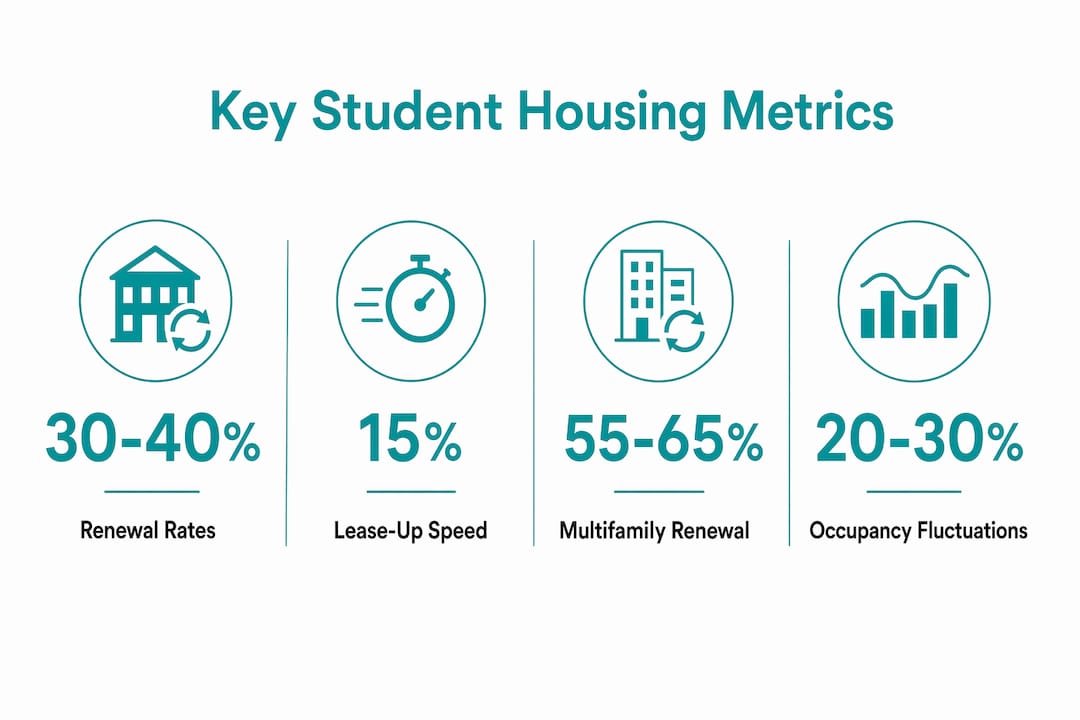
Student housing renewal rates average 30% to 40%, compared to 55% to 65% for conventional multifamily. That gap is not a coincidence. It reflects the transient nature of the student population and the absence of targeted retention programs at many properties. Closing that gap by even 10 percentage points has a direct impact on turnover costs and cash flow predictability.
The table below summarizes the core metrics operators should track and their typical ranges:
Metric | Typical Range | Why It Matters |
Occupancy by bed | 92%–98% at peak | Reveals true revenue exposure at the bed level |
Pre-leasing velocity | 50%–70% leased by January | Signals demand health for the upcoming academic year |
Renewal rate | 30%–40% | Benchmarks retention against the broader market |
Turnover cost per bed | $500–$1,500 | Quantifies the financial impact of high churn |
Rent growth year over year | 2%–5% | Tracks pricing power relative to market conditions |
Key data inputs to track alongside these metrics include:
Student-to-bed ratios at the target university, which signal demand pressure or softness
Concession trends in your comp set, which indicate whether the market is tightening or loosening
Monthly pre-leasing pace compared to the prior year at the same point in the cycle
Pro Tip: Set a weekly pre-leasing tracker starting in october. Comparing your pace week over week against the prior year gives you an early warning signal before the leasing window closes.
Properties that integrate data analytics see up to 30% faster lease-up times and 15% higher tenant retention rates. That advantage comes from acting on real-time signals rather than waiting for end-of-month reports.

How do turnover and lease renewal strategies impact revenue?
Turnover is the single largest controllable cost in student housing. When a bed sits vacant for even two weeks during the summer turn, you absorb lost rent, cleaning costs, maintenance, and re-leasing expenses. Multiply that across 100 beds and the financial exposure becomes significant fast.
Early renewal programs that launch 5 to 6 months before lease expiration reduce income volatility by locking in known residents before the open market competes for them. The incentive does not need to be large. A modest rent discount, a waived application fee, or a preferred unit selection window is often enough to move a student to sign early. The key is timing and consistency.
Five renewal tactics that protect income in student housing:
Launch renewal outreach in october for august lease expirations, not in the spring
Offer early signers a unit or roommate preference, not just a discount
Automate follow-up sequences so no resident falls through the cracks between october and february
Use roommate matching programs to reduce mid-lease conflicts that trigger early move-outs
Standardize the move-out communication process so residents know their obligations early
Automated renewal communications that start 5 to 6 months before expiration improve lease renewal rates and help stagger move-outs. Staggered move-outs protect cash flow by preventing a single-week vacancy spike that strains maintenance and cleaning capacity.
Roommate conflicts are an underappreciated driver of mid-lease turnover. A resident who leaves early because of a roommate issue costs you far more than a resident who simply does not renew. Proactive roommate matching and a clear conflict resolution process reduce this risk without requiring significant staff time.
Pro Tip: Track your outreach-to-renewal conversion rate by contact method. If email converts at 12% and text converts at 34%, shift your cadence accordingly. Most operators never measure this.
What pricing strategies work best in student housing?
Pricing in student housing requires balancing two competing pressures: leasing velocity and rent growth. Push rents too high early in the season and you fall behind on pre-leasing. Drop rents too fast to fill beds and you leave money on the table when demand is still strong. Neither outcome serves the asset.
Dynamic pricing models that adapt through the academic leasing season outperform fixed tiered rates by responding to actual demand signals rather than predetermined price points. A tiered pricing approach sets rates by unit type and holds them through the season. A dynamic approach adjusts rates based on remaining availability, pre-leasing pace, and market movement. For most student housing operators, a hybrid works best: set tiered rates as a starting point, then adjust dynamically as the season progresses.
The per-bed lease structure enhances revenue control by enabling individual marketing, pricing flexibility, roommate reassignments, and tailored collections. This is a structural advantage that conventional multifamily does not have. You can price a top-floor corner bed at a premium while filling a ground-floor interior bed at a discount, all within the same unit.
Pricing considerations by configuration:
Studio and one-bedroom units: price on total rent, comparable to conventional multifamily
Two and three-bedroom units: price by bed, with premiums for preferred floors or views
Four-bedroom units: use bed-level pricing with roommate matching to reduce vacancy risk
Seasonal demand shifts also create a revenue opportunity that most operators ignore. Monetizing the summer occupancy trough through short-term leases to visiting academics, interns, and summer program participants generates income during a period that otherwise sits vacant. This requires a separate lease structure and operational readiness, but the revenue impact is real.
For a deeper look at room rental pricing models and how they apply to per-bed leasing, the comparison of fixed versus dynamic structures is worth reviewing before setting your annual pricing posture.
Pro Tip: Review your pricing by bed type every two weeks during the leasing season, not monthly. The window to adjust is short, and a two-week delay can cost you meaningful rent growth.
How does forecasting and operational discipline drive revenue success?
Forecasting in student housing starts with enrollment data, not just prior-year occupancy. If the target university announces a 5% enrollment increase, your demand assumptions should reflect that before the leasing season opens. If enrollment contracts, you need to know early enough to adjust pricing and concessions before competitors do.
Advanced underwriting analyzes monthly debt service coverage ratios across academic and summer cycles to anticipate liquidity risks tied to seasonal occupancy fluctuations. This is not just an investor concern. Operators who model monthly cash flow rather than annual averages catch DSCR pressure points before they become a lender conversation.
Student housing leases often result in 80% to 100% annual turnover concentrated in a single month. That concentration makes the annual turn a make-or-break operational event. Operators who treat it like a manufacturing process, with precise scheduling, vendor coordination, and unit readiness targets, protect NOI. Those who manage it reactively absorb delays, cost overruns, and late move-ins.
Operational workflows that support revenue stability:
Pre-turn inspections completed 60 days before move-out to identify capital needs early
Vendor contracts finalized before june so labor and materials are secured
Unit readiness checklists that define “rent-ready” with no ambiguity
Weekly review cadence that tracks bed-level occupancy, pre-leasing pace, and renewal progress
Investor reporting that connects operational metrics to cash flow projections
Operators who reduce turn cycles to under 7 days per unit using standardized processes see a 15% to 20% NOI uplift compared to reactive management. That uplift comes from fewer lost rent days, lower emergency vendor costs, and faster re-leasing readiness. The process discipline is the strategy. Software supports it, but it does not replace it.
Integrating operational KPIs with investor reporting builds confidence and transparency in managing seasonal cash flow risks. Investors who see weekly pre-leasing pace, renewal rates, and turn timelines alongside cash flow projections make better decisions and ask better questions.
Key Takeaways
Effective student housing income management requires early action, bed-level precision, and operational discipline applied consistently across every leasing cycle.
Point | Details |
Track bed-level metrics | Occupancy by bed, pre-leasing velocity, and renewal rate are the core KPIs for student housing. |
Start renewals early | Launch renewal outreach 5 to 6 months before lease expiration to reduce turnover and protect cash flow. |
Use dynamic pricing | Adjust rates based on leasing velocity and remaining availability, not fixed tiers alone. |
Treat the turn as a process | Standardized turn cycles under 7 days correlate with 15% to 20% NOI improvement. |
Model monthly cash flow | Analyze DSCR by month across academic and summer cycles to catch liquidity risks early. |
What I’ve learned about student housing that most guides skip
Student housing is not a passive investment. It is an operating business with a hard deadline every august, and the operators who treat it that way consistently outperform those who do not. I have seen well-capitalized properties underperform because the team waited until march to start renewal conversations. By then, the student who might have stayed has already signed somewhere else.
The thing that surprises most investors new to this asset class is how much of the revenue outcome is determined before the leasing season even opens. Your pricing posture, your renewal program, your vendor relationships, your turn schedule. All of it needs to be in place by october for an august lease expiration. If you are building that plan in january, you are already behind.
I also want to push back on the idea that a revenue management platform solves the student housing problem. Software is useful. But if your data is messy, your lease expirations are not managed, and your team is not reviewing performance weekly, the platform will just automate bad decisions faster. The fundamentals of leasing with revenue management apply here as much as anywhere in multifamily.
One more thing: communicate with parents and guarantors, not just students. In student housing, the financial decision-maker is often not the resident. A clear, professional renewal communication sent to the guarantor alongside the student dramatically improves response rates and reduces the “I need to ask my parents” delay that kills renewal momentum.
— Joani Schumaker
Working with The Revenue Method on student housing strategy
Student housing requires a different operating framework than conventional multifamily, and getting the fundamentals right from the start saves significant time and money.

The Revenue Method works with property managers and investors to build pricing strategy, renewal programs, and operational workflows tailored to the academic calendar. That includes amenity pricing reviews, lease expiration management through ExpirationIQ, and advisory support that is independent of any software vendor. If you are building or refining your approach to student housing revenue, The Revenue Method provides the strategic guidance and operational structure to make it work. The goal is a repeatable system that protects income every leasing cycle, not a one-time fix.
FAQ
What are student housing revenue management fundamentals?
Student housing revenue management fundamentals are the core practices of aligning pricing, occupancy, and operations with the academic calendar to protect income and reduce vacancy. They include bed-level pricing, early renewal programs, turn management, and seasonal demand forecasting.
How do renewal rates in student housing compare to conventional multifamily?
Student housing renewal rates average 30% to 40%, compared to 55% to 65% in conventional multifamily. That gap reflects the transient student population and the absence of targeted retention programs at many properties.
When should renewal outreach start in student housing?
Renewal outreach should start 5 to 6 months before lease expiration. For august lease-end dates, that means launching renewal communications in october to capture early signers before the open market competes for them.
What is the financial impact of reducing turn cycle times?
Operators who reduce turn cycles to under 7 days per unit through standardized processes see a 15% to 20% NOI improvement compared to reactive management. Fewer lost rent days and lower emergency vendor costs drive the majority of that gain.
How does per-bed leasing affect pricing strategy?
Per-bed leasing allows operators to price individual beds within a unit based on floor, view, or configuration, rather than setting a single unit rent. This structure gives you more pricing flexibility and the ability to fill partial vacancies without discounting the entire unit.
Recommended

Comments