


Renovation Rent Premium for Multifamily Owners: 2026 Guide

A renovation rent premium is the additional monthly rent a renovated unit commands over what the same unit would lease for in its pre-renovation condition. Done right, it is one of the most reliable levers in multifamily value creation. Done wrong, it burns capital, disrupts residents, and produces a premium that exists only on paper.
The honest rule of thumb: light-touch upgrades typically yield $50–100/month, classic value-add scopes in a moderate range of monthly rent premiums, and heavy-lift gut renovations $200–350/month. Those ranges are wide because submarket conditions, execution quality, and the resident base you are working with all move the number significantly. Renovations reliably produce premiums when the comp set supports the upgraded finish level and your leasing team can price and hold the new rate. They do not when you over-specify for the neighborhood, skip the pilot, or assume the market will absorb a premium it has never demonstrated.
Four factors determine whether your achievable premium lands at the top or bottom of those ranges:
Local comp alignment: What are renovated units in your immediate submarket actually leasing for?
Scope fit: Does the renovation match what renters in that price band expect and will pay for?
Execution quality: Consistent finish quality across units is what holds the premium at renewal.
Tenant base: Existing residents’ income levels and willingness to pay set a ceiling on what new asking rents can achieve.
Pro Tip: Run a quick comp check before you finalize scope. Pull 10–15 recently leased renovated units within a one-mile radius and note their finish level. That is your ceiling, not your aspiration.
Key Takeaways
Renovation rent premiums are real and repeatable, but only when the scope matches the submarket, the pilot validates the price, and the leasing team holds the rate through a disciplined pricing cadence.
Point | Details |
Match scope to the comp set | Renovated comps in your submarket set the premium ceiling. Over-specifying wastes capital. |
Pilot before scaling | Renovate 5–10% of units first and track net effective rent for 90 days before committing the full budget. |
Underwrite to achievement rate | Model a conservative 75% achievement rate; the gap between 75% and 100% can swing value uplift by nearly $1M on a 100-unit deal. |
Track rent capture monthly | Net effective rent divided by asking rent below 95% for 60+ days signals a pricing or concession problem. |
The Revenue Method | Advisory engagements cover pilot design, pro forma review, and pricing cadence to validate premiums before full rollout. |
Table of Contents
How to calculate a renovation rent premium (with worked examples)
The math is straightforward. The discipline is in using honest inputs.
Core formulas:
Monthly premium: Renovated asking rent minus pre-renovation market rent for the same unit type.
Return on cost: (Annual premium × occupancy rate) ÷ renovation cost per unit.
Payback period (months): Renovation cost per unit ÷ monthly premium.
NOI uplift: Monthly premium × occupied units × 12.
Value uplift: NOI uplift ÷ exit cap rate.
Institutional practice targets roughly 20–22% return on cost for renovation capex.
Example 1: Light refresh (paint, fixtures, hardware)
Cost per unit: $5,000
Monthly premium: $75
Annual premium per unit: $900
Return on cost: $900 ÷ $5,000 = 18%
Payback: 67 months (~5.5 years)
NOI uplift (100 units): $85,500/year
Value uplift: $85,500 ÷ 5.5% = $1.55M
Example 2: Classic value-add (kitchen, bath, flooring)
Cost per unit: $15,000
Monthly premium: $175
Annual premium per unit: $2,100
Return on cost: $2,100 ÷ $15,000 = 14%
Payback: 86 months (~7 years)
NOI uplift (100 units): $199,500/year
Value uplift: $199,500 ÷ 5.5% = $3.63M
Example 3: Heavy lift (full gut, in-unit laundry, HVAC)
Cost per unit: $30,000
Monthly premium: $275
Annual premium per unit: $3,300
Return on cost: $3,300 ÷ $30,000 = 11%
Payback: 109 months (~9 years)
NOI uplift (100 units): $313,500/year
Value uplift: $313,500 ÷ 5.5% = $5.7M
That does not automatically kill the deal, but it means the underwriting must rely on a strong achievement rate and a tightening exit cap to pencil. Targeted upgrades raising average rents by a moderate amount per unit at typical occupancy can generate a large additional annual revenue, which at an industry-standard cap rate implies multi-million dollar added asset value… The math scales fast, which is exactly why the inputs need to be honest.
Input | Light Refresh | Classic Value-Add | Heavy Lift |
Cost per unit | $5,000 | $15,000 | $30,000 |
Monthly premium | $75 | $175 | $275 |
Return on cost | 18% | 14% | 11% |
Payback (months) | 67 | 86 | 109 |
NOI uplift (100 units) | $85,500 | $199,500 | $313,500 |
Value uplift at 5.5% cap | $1.55M | $3.63M | $5.7M |
Which renovations actually drive rent premiums?
Kitchens and bathrooms consistently deliver the highest premium per dollar spent. Flooring is close behind because it is the first thing a prospect notices on a tour. Everything else is context-dependent.

Energy-efficiency upgrades like HVAC replacements serve a dual purpose: they reduce operating expense and can be marketed as a resident benefit that supports higher asking rents. That double-dip on return is worth modeling explicitly.
In-unit laundry is the outlier in the table above. The payback is shorter than almost any other scope because the premium is sticky: residents who have in-unit laundry rarely move to a building without it, which improves renewal conversion and reduces turnover costs. Amenity optimization at the property level works the same way: aligning what you offer with what residents will actually pay for is a revenue lever that complements unit-level upgrades.
Market adjustment matters here. A $14,000 kitchen renovation in a Class B suburban submarket where renovated comps lease at $1,400/month will not produce the same premium as the same scope in a Class A urban market where comps lease at $2,200/month. Match your finish level to the comp set, not to what looks good on a property tour.
Pro Tip: *Avoid spec creep. Quartz countertops and custom tile backsplashes belong in a market where renovated comps already show them.
What does a phased renovation rollout actually look like?
Phased execution reduces vacancy exposure and gives you real market data before you commit the full capital budget. Here is how operators typically sequence it:
Phase 1: Planning and scope (4–8 weeks). Pull comp data, finalize unit specs, get contractor bids, and identify your pilot units. Do not skip the comp pull. Your scope decision should be anchored to what renovated units in your submarket are actually leasing for today.
Phase 2: Contractor procurement (2–4 weeks). Solicit at least three bids per scope. Negotiate unit-rate pricing for the full program upfront even if you are only committing to the pilot. Contractors price better when they see volume.
Phase 3: Pilot execution (4–8 weeks per unit turn). Renovate 5–10% of your unit count, prioritizing naturally vacating units to avoid displacement costs. Track actual turn time, cost per unit, and finish quality against spec.
Phase 4: Measurement window (60–90 days post-lease-up). This is where most operators rush and get burned. You need at least two to three leases at the new asking rent before you can call the premium validated. Watch concession levels closely: a unit that leases at $175 over prior rent but requires a month of free rent has not actually captured $175.
Phase 5: Scale-up decision. If pilot units are leasing at or above the underwritten premium with minimal concessions, expand. If they are not, adjust scope or pricing before committing the remaining capital.
Phased rollout and monitoring of renovated units provide essential validation for underwriting assumptions, and substantial renovations tend to produce stronger rent growth both during the renovation period and for up to two years after completion.
Pro Tip: Select pilot units that represent your most common floor plan. Piloting your rarest unit type gives you data that does not transfer to the rest of the portfolio.
How to underwrite renovation ROI across three scenarios
Underwriting a renovation program requires more than a return-on-cost calculation. You need to stress-test the inputs that move the outcome most.
Underwriting checklist before you commit capital:
Baseline rent roll: current in-place rents by unit type, lease expiration schedule, and recent concession history.
Achievable comp check: renovated comps within one mile, filtered by unit type and finish level.
Renovation cost estimate: contractor bids plus a 10–15% contingency.
Vacancy and reserve assumptions: typical turn time, lease-notice patterns from BLS data, and any displacement costs for occupied units.
Financing costs: if the renovation is debt-financed, model the carry cost against the premium timeline.
Exit cap assumption: what cap rate are you underwriting the exit at, and how sensitive is your value uplift to a 25-basis-point move?
The achievement rate is the variable most operators underestimate. It is the share of renovated units that actually lease at the underwritten premium rather than at a discount or with concessions that erode the net effective rent. Industry practice identifies the achievement rate as the largest variance driver in value-add outcomes.
Here is a three-scenario model for a 100-unit property, classic value-add scope ($15,000/unit, $175/month underwritten premium):
Scenario | Achievement Rate | Effective Premium | Annual NOI Uplift | Value Uplift (5.5% cap) | Notes |
Conservative | 75% | $175/month | $199,500 | $3.63 million | Concessions, soft leasing |
Expected | 90% | $275/month | $313,500 | $5.7 million | Normal market absorption |
Optimistic | 100% | $175/mo | $199,500 | $3.63M | Strong submarket, tight supply |
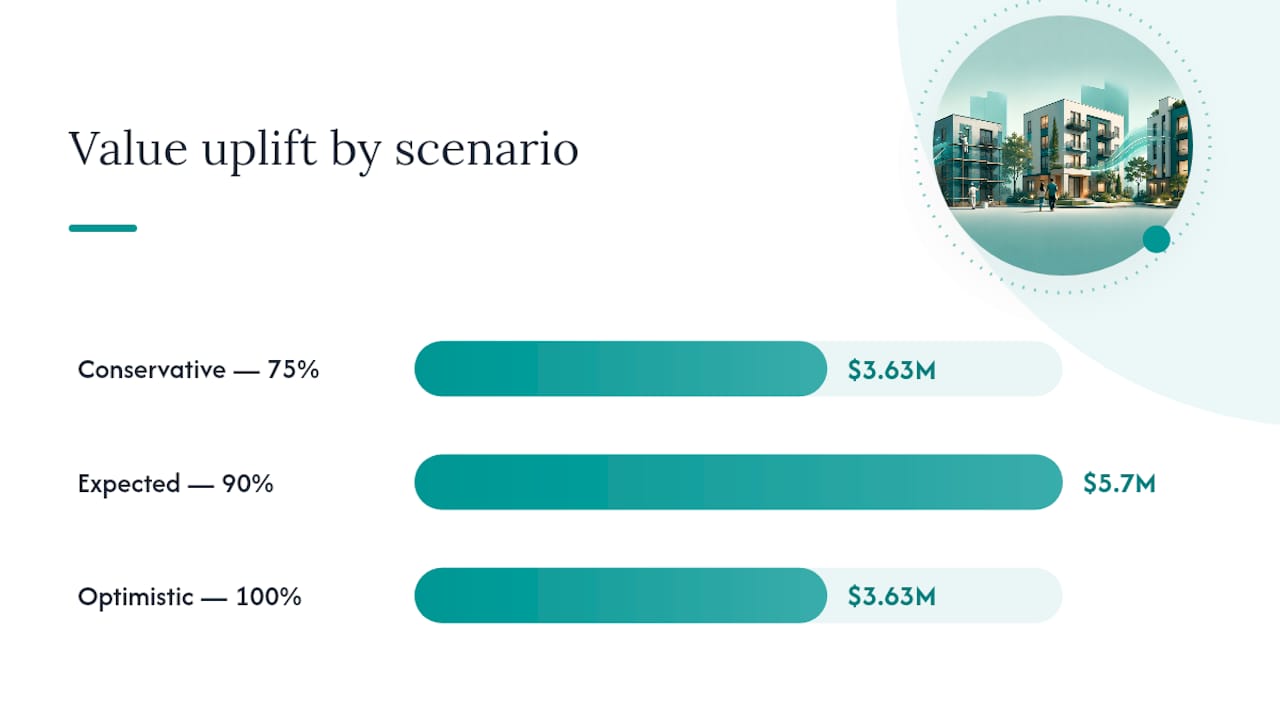
The swing between conservative and optimistic is nearly $1M in value. That is why the achievement rate deserves its own sensitivity line in every pro forma. In the current market environment, renovation premium must often carry the deal because national rent-growth tailwinds are weak, which means a conservative achievement rate assumption is not pessimism: it is discipline.
How to test and validate your premium before scaling
A pilot is not a soft launch. It is a structured market test with defined success criteria. Here is the playbook:
Select 5–10 units from naturally vacating inventory. Prioritize your most common floor plan and a mix of floor levels if your building has meaningful floor-premium variation.
Set asking rent at the full underwritten premium from day one. Do not discount to lease faster. You need to know whether the market will absorb the price, not whether it will absorb a discounted version of it.
Define your concession guardrail. If you need more than two weeks of free rent to lease a pilot unit, that is a signal the premium is too high or the scope is not differentiated enough from what the comp set already offers.
Track these metrics weekly during lease-up:
Rent capture rate (net effective rent vs. asking)
Days on market vs. non-renovated units
Tour-to-application conversion rate
Concession value as a percentage of annual rent
Maintenance tickets in the first 60 days (a proxy for finish quality)
Set a 90-day measurement window before making the scale-up call. Two or three leases is a data point. Six to eight leases is a pattern.
Review renewal intent at month 10 for pilot units. A premium that leases well but does not renew is a churn machine, not a value-add.
Operators who run a structured pilot reduce the risk of over-capitalizing because the rent roll becomes proof of concept before the full budget is deployed. Use your revenue management setup to track asking versus effective rent weekly so concession drift does not hide a soft premium.
Pro Tip: If pilot units are leasing but only with concessions that exceed your reserve assumption, do not expand the scope. Adjust the asking rent or the finish level first. Scaling a broken premium just multiplies the problem.
Tenant impacts, regulatory checks, and renovation risks you cannot ignore
Renovation programs fail in predictable ways. Most of them are avoidable.
Permit and regulatory checks to complete before construction starts:
Pull building permits for all structural, electrical, plumbing, and HVAC work. Unpermitted work creates liability at exit.
Verify local rent increase notice requirements. Most U.S. jurisdictions require 30–60 days written notice for rent increases; some require more for increases above a set percentage.
Check whether your city or county has rent stabilization or rent control ordinances. Several major metros and California municipalities cap allowable rent increases regardless of renovation scope.
Confirm relocation assistance obligations if you are renovating occupied units. Some jurisdictions require landlords to pay temporary relocation costs.
Tenant-impact risks that erode real premium:
Displacement costs (temporary housing, moving allowances) can run $2,000–$5,000 per unit in markets with relocation ordinances, which directly reduces your net renovation ROI.
Construction disruption in occupied buildings increases maintenance tickets, complaint volume, and early lease terminations. Budget for it.
Concessions used to lease renovated units mask the true net effective rent. A unit leasing at $175 over prior rent with six weeks of free rent has a net effective premium closer to $90 in year one.
Retention loss among long-term residents who feel priced out after renovation is a real cost. High turnover in a newly renovated building signals a mismatch between the renovation scope and the existing resident base.
Red flags that the scope is too aggressive for your submarket:
Renovated comps in your immediate submarket are not leasing at the premium you are underwriting.
Your current resident base has household incomes that cannot support the new asking rent.
Vacancy in renovated units at competing properties is running above 10%.
Your leasing team is already using concessions to hold current rents.
Pro Tip: Talk to your leasing team before you finalize scope. They know which features prospects ask about on tours and which ones go unnoticed. That conversation is free market research.
Your pre- and post-renovation checklist
Use this as a working document, not a one-time review.
Pre-renovation:
Pull 10–15 renovated comp leases within one mile, filtered by unit type and finish level.
Review your rent roll for lease expiration clustering. Renovating units with leases expiring in the next 90 days minimizes displacement costs.
Confirm your renovation cost estimate includes a 10–15% contingency and a realistic turn-time assumption.
Verify permit requirements and local rent increase notice rules with your property attorney.
Identify pilot units (5–10% of total count, most common floor plan).
During renovation:
Inspect every pilot unit before releasing to leasing. Finish quality inconsistency is the fastest way to lose the premium at renewal.
Track actual cost per unit against bid. Cost overruns above 15% should trigger a scope review before you expand.
Communicate the renovation timeline to current residents in writing, with a clear point of contact for questions.
Post-renovation:
Track rent capture rate monthly: net effective rent divided by asking rent. Anything below 95% for more than 60 days signals a pricing or concession problem.
Monitor renewal conversion on renovated units separately from the rest of the portfolio. A drop in renewal rate is an early warning sign.
Track turnover costs on renovated units. Higher-than-average turnover erodes the NOI uplift faster than most pro formas account for.
Review leasing best practices to align your team’s concession strategy with the premium you are trying to hold.
Use a CapEx prioritization framework to evaluate each subsequent renovation dollar by rent-lift potential, renewal impact, operating-cost reduction, and exit-value enhancement. That discipline keeps you from chasing scope for its own sake.
Communication dos and don’ts:
Do give residents written notice of renovation timelines, scope, and any temporary disruptions at least 30 days in advance.
Do offer a direct contact for renovation-related concerns. Unaddressed complaints become lease terminations.
Do not promise a specific completion date you cannot control. Contractor delays are common; overpromising destroys trust.
Do not raise rent on existing residents mid-lease without legal authority to do so. Review your lease terms and local law first.
What operators consistently get wrong about renovation premiums
The most common mistake I see is operators who underwrite to the optimistic scenario and then skip the pilot. They commit the full capital budget based on what renovated comps are asking, not what they are actually leasing for net of concessions. By the time the rent roll tells the real story, they have already renovated 80 units.
The second mistake is treating the renovation as the finish line. The premium does not capture itself. You need a weekly pricing cadence, a leasing team that knows how to hold the rate, and a concession policy with actual guardrails. Software can support that process, but the strategy has to come first. Clean data, consistent pricing discipline, and human oversight are what convert a renovation into a durable NOI improvement.
The third thing I would flag: do not ignore amenities. Finding hidden revenue with amenities is often faster and cheaper than a full unit renovation program, and it can make your renovated units more competitive without adding to the per-unit capital budget. The two levers work together.
Finally, in the current market, conservative underwriting is not a weakness. With national rent growth running below historical averages, the premium has to carry the deal on its own. Model your conservative scenario first, and only proceed if it still pencils.
The Revenue Method helps you validate and capture renovation premiums
Renovation programs succeed when the strategy is right before the first unit is touched. The Revenue Method provides advisory and implementation support for multifamily owners and asset managers who want to underwrite, pilot, and price renovation programs without guessing.
A typical engagement covers pilot unit selection, pro forma review, pricing cadence setup, concession guardrail design, and weekly performance tracking during lease-up. The goal is to get your rent roll to confirm the premium before you scale, not after. No software sales, no vendor referrals. Just clear advisory work tied to your specific asset, submarket, and resident base.
If you are planning a renovation program and want a second set of eyes on the underwriting or the pilot design, reach out to The Revenue Method to start the conversation.
Sources
Recommended

Comments