


Revenue Management Vendor Neutrality: A 2026 Guide

Revenue management vendor neutrality is defined as the practice of advising on and executing pricing strategy without financial bias toward any single software platform, inventory source, or vendor relationship. For real estate professionals and investors, this distinction matters more than most realize. The advisor sitting across from you may be certified in a platform they also profit from recommending. That conflict shapes every recommendation they make, whether they acknowledge it or not. Understanding what true neutrality requires, and how to verify it, is the starting point for making better software and strategy decisions in 2026.
What is revenue management vendor neutrality?
Vendor neutrality in revenue management requires three structural conditions: the advisor does not own or operate any inventory, has access to a broad and multi-source portfolio of solutions, and receives no financial benefit from steering clients toward any particular platform or vendor.

The industry term for this concept is “vendor-neutral advisory.” The phrase “vendor neutrality” is widely used in managed service programs and technology consulting, but the underlying principle is the same across sectors. A neutral advisor functions as an impartial referee rather than a player. That distinction matters because the referee has no stake in the outcome beyond the quality of the game.
In multifamily revenue management, neutrality is violated the moment an advisor earns a referral fee, holds a revenue share agreement with a software company, or defaults to recommending the one platform they know best. Advisors funded by vendor commissions bias their recommendations toward the vendors that pay them, not the platforms that best serve your asset. That is not a flaw in the individual. It is a structural problem built into the compensation model.
The Revenue Method is certified across six revenue management platforms and operates without referral agreements or vendor commissions. That structure is what makes objective software evaluation possible.
What structural conditions define true vendor neutrality?
True neutrality is not a marketing claim. It is a set of verifiable structural conditions. Before you accept any advisor’s claim of neutrality, check for the following:
No inventory ownership or operational control. Neutrality requires that the advisor does not own or manage the properties for which they are recommending pricing strategies. Ownership creates an inherent conflict between portfolio performance and objective advice.
Access to multi-source, diverse solution pools. A neutral advisor evaluates multiple platforms across the full market, not just the two or three they are certified in or affiliated with.
No algorithmic prioritization favoring any vendor. If the advisor’s process routes clients toward one platform by default, that is a structural bias regardless of intent.
Transparent, explicit fee structures. Independent consultants charge explicit fees with no referral commissions. The client pays the advisor directly. The advisor’s income does not depend on which software you buy.
Independent funding. Vendor-neutral programs must be funded independently from other revenue streams. Cross-funding through supplementary vendor relationships undermines genuine impartiality.
A non-neutral setup looks like this: a consultant recommends a revenue management system, receives a referral fee from that system’s provider, and then supports the implementation. Every step of that process is shaped by the financial relationship, not by what is best for your portfolio.
Pro Tip: Ask every advisor you evaluate this exact question: “Do you receive any compensation, referral fees, or revenue sharing from the software companies you recommend?” The answer tells you everything about the quality of advice you will receive.
How does vendor neutrality compare to integrated vendor solutions?
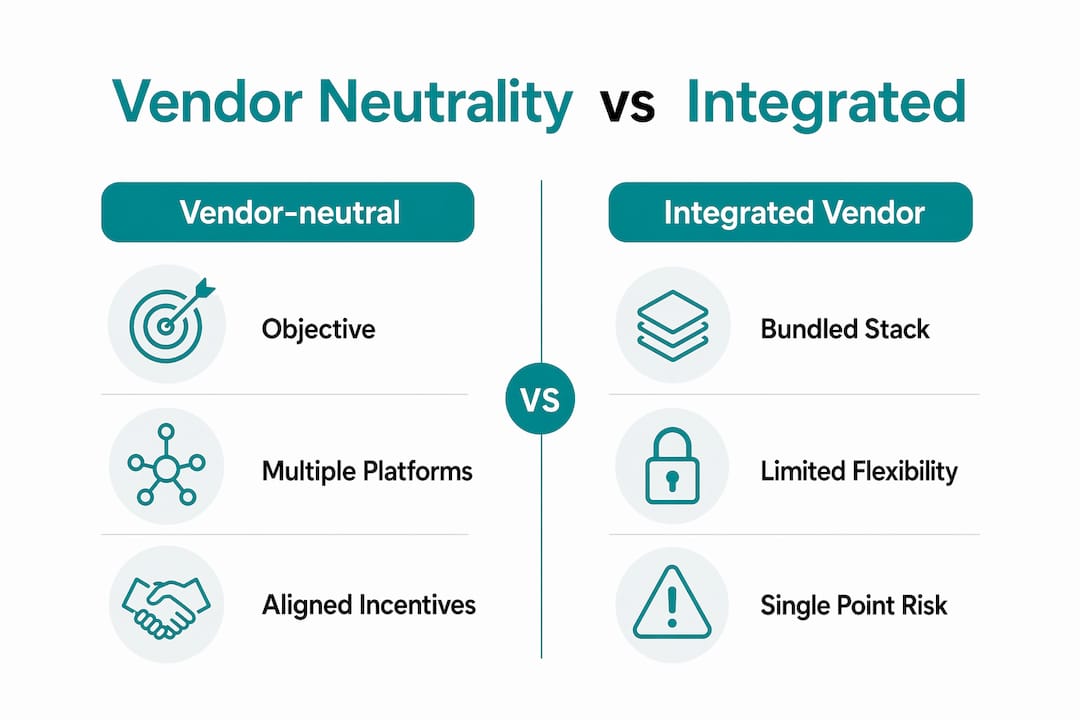
The appeal of integrated vendor stacks is real. Bundling your property management system, revenue management system, and channel management under one vendor simplifies contracting, reduces integration headaches, and creates a single support relationship. For operators who are short on time and technical resources, that convenience is genuinely valuable.
The cost of that convenience is flexibility. Vendor-integrated stacks bundle PMS, RMS, and channel management in ways that reduce pricing portability, increase switching costs, and create monopolistic vendor dependency over time. When your entire revenue stack lives inside one vendor relationship, your negotiating leverage at renewal is close to zero.
Factor | Vendor-neutral model | Integrated vendor model |
Software selection | Objective, multi-platform evaluation | Limited to vendor’s own ecosystem |
Pricing portability | High: components can be swapped independently | Low: switching one tool often requires switching all |
Negotiation leverage | Preserved: vendors compete for your business | Reduced: vendor controls renewal terms |
Implementation support | Independent, asset-specific guidance | Vendor-provided, platform-specific |
Benchmarking objectivity | Objective across platforms | Biased toward vendor’s own metrics |
Switching costs | Lower: modular stack design | Higher: full platform migration required |
Platform consolidation creates a single point of failure. If your integrated vendor has a roadmap decision that does not serve your asset type, you have no recourse short of a full migration. Operators who choose integrated stacks by default, rather than by deliberate design, often discover this limitation only when they need to change something.
The right answer is not always full neutrality across every component. Some integration is practical. The goal is to make that choice deliberately, with a clear understanding of what you are trading away.
Pro Tip: Separating at least one revenue management capability outside your primary vendor stack preserves negotiation leverage at contract renewal. You do not need a fully modular stack to benefit from neutrality. You need enough independence to walk away.
What are the financial and strategic impacts of vendor neutrality?
The financial case for vendor neutrality in revenue management comes down to incentive alignment. When your advisor’s income depends on which software you buy, their incentives are misaligned with your revenue outcomes. When they are paid directly by you for measurable results, the incentives point in the same direction.
Performance-based consulting models index fees to measurable revenue improvement rather than fixed software license fees. That structure creates mutual accountability. The advisor wins when the asset wins. Fixed license fees, by contrast, are paid regardless of whether the platform is configured correctly, used effectively, or generating any return.
The hidden costs in non-neutral models are worth naming directly:
Referral fees embedded in software license structures that you never see as a line item
Implementation support that defaults to the vendor’s preferred configuration rather than your asset’s actual needs
Benchmarking reports that use the vendor’s own data to evaluate the vendor’s own performance
Renewal pricing that reflects your switching costs, not your asset’s value to the vendor
“Neutral vendors act as impartial referees and avoid prioritizing their own managed inventory, enforcing fair benchmarking essential for maximizing returns in fragmented real estate markets.” Candidately Vendor Neutrality Glossary
Maintaining vendor neutrality hedges against contract renegotiation risk by preserving negotiation leverage and preventing monopolistic pricing at renewal. For a portfolio with multiple assets across different markets, that leverage compounds over time. The operator who can credibly threaten to switch platforms negotiates from a fundamentally different position than the one who is locked in.
The strategic impact extends beyond cost. Neutral advisory produces objective performance comparisons. You can evaluate whether your current revenue management system is actually performing relative to alternatives, not just relative to its own prior period. That kind of benchmarking is only possible when the advisor has no stake in the answer.
How can you apply vendor neutrality principles when selecting software and advisors?
Applying vendor neutrality in practice means building a structured evaluation process rather than defaulting to whoever your PMS vendor recommends. Here is how to approach it:
Map your current vendor relationships. List every software contract, integration, and advisory relationship. Note which vendors have financial relationships with each other. This gives you a baseline picture of where conflicts of interest already exist in your stack.
Ask direct questions about compensation. Before engaging any consultant or advisor, ask how they are compensated, whether they receive referral fees, and which platforms they are certified in. Cross-reference their recommendations against their financial relationships.
Evaluate multi-platform capability. A neutral advisor should be able to evaluate at least three to four revenue management platforms against your specific asset profile. If they only recommend one or two, ask why. The answer should be asset-specific, not relationship-specific.
Assess portfolio-wide insights. Vendor neutrality becomes especially valuable at the portfolio level. An advisor who can benchmark performance across assets, markets, and platforms gives you information that a single-vendor relationship cannot produce. Review revenue management software shopping frameworks before you start any evaluation process.
Balance convenience with strategic control. Operational convenience is a legitimate consideration. The goal is not to maximize complexity. The goal is to make integration decisions deliberately, with a clear understanding of what flexibility you are trading away and why.
Review the advisor’s certification breadth. Certification across multiple platforms is a proxy for genuine multi-platform capability. An advisor certified in one platform has limited ability to objectively compare it against alternatives.
For multifamily operators specifically, the apartment revenue management setup process is where vendor neutrality pays off most directly. The configuration decisions made at setup shape pricing behavior for years. Getting those decisions from a neutral advisor rather than a vendor-aligned one changes the quality of every recommendation that follows.
Key Takeaways
Vendor neutrality in revenue management is the structural condition that makes objective pricing advice possible. Without it, every recommendation is shaped by the advisor’s financial relationships, not your asset’s needs.
Point | Details |
Neutrality is structural, not claimed | Verify compensation models, certification breadth, and inventory independence before trusting any advisor. |
Integrated stacks trade flexibility for convenience | Bundled vendor relationships reduce negotiation leverage and increase switching costs over time. |
Incentive alignment drives better outcomes | Performance-based advisory fees align consultant income with your revenue results, not software sales. |
Hidden costs compound in non-neutral models | Referral fees, biased benchmarking, and renewal pricing all erode returns in vendor-dependent relationships. |
Neutrality preserves negotiation leverage | Keeping at least one revenue management component outside your primary vendor stack protects your position at renewal. |
Why I think vendor neutrality is the most overlooked risk in multifamily revenue management
Most operators I work with are not thinking about vendor neutrality when they select a revenue management system. They are thinking about features, pricing, and whether the platform integrates with their PMS. Those are legitimate considerations. But they are the wrong starting point.
The starting point should be: who is advising me on this decision, and what do they earn if I say yes?
I have seen operators locked into platforms that no longer serve their asset profile because switching costs are prohibitive. I have seen benchmarking reports that use the vendor’s own data to validate the vendor’s own performance. I have seen implementation support that configures the system the way the vendor prefers, not the way the asset operates. None of that is fraud. It is the predictable result of misaligned incentives.
The operators who get the most out of revenue management are not the ones with the most sophisticated software. They are the ones with clean data, good setup, consistent human oversight, and advisors who have no stake in which platform they use. Software is a tool. The strategy is what you bring to it.
Vendor dependency is a slow-building risk. You do not feel it on day one. You feel it at renewal, when the vendor knows your switching costs better than you do. The operators who preserve neutrality from the start are the ones who negotiate from strength, not from necessity.
— Joani Schumaker
Work with an advisor who has no stake in what you buy
If you are evaluating revenue management software or questioning whether your current setup is actually working for your assets, The Revenue Method offers independent advisory with no vendor commissions and no referral relationships.

The Revenue Method is certified across six platforms and advises operators across multifamily, build-to-rent, and student housing portfolios. The work covers software evaluation and selection, implementation support, pricing strategy, lease expiration management, and operational review. Every recommendation is based on your asset’s needs, not on which vendor pays a referral fee. If you want a second opinion on your current stack or guidance on a new selection, that is exactly what The Revenue Method is built for.
FAQ
What is vendor neutrality in revenue management?
Vendor neutrality in revenue management means the advisor has no financial stake in which software or platform you select. It requires no referral commissions, no inventory ownership, and transparent client-funded compensation.
How do I know if my revenue management consultant is truly neutral?
Ask directly whether they receive referral fees or revenue sharing from any software company they recommend. A neutral advisor is paid only by the client and can evaluate multiple platforms objectively.
What are the risks of using a vendor-integrated revenue management stack?
Integrated stacks reduce pricing portability and negotiation leverage at renewal. If one component underperforms, replacing it often requires migrating the entire stack.
Does vendor neutrality mean avoiding all software integrations?
No. Vendor neutrality means making integration decisions deliberately, with full awareness of the trade-offs. Some integration is practical. The goal is to preserve enough independence to negotiate effectively and switch components when needed.
Why does vendor neutrality matter more at the portfolio level?
At the portfolio level, objective benchmarking across assets and markets requires an advisor with no stake in the results. A vendor-aligned advisor cannot objectively compare performance across platforms they have financial relationships with.
Recommended

Comments