


The Role of Lease-Up Risk Asset Managers Explained

Lease-up risk asset managers are the operators who stand between a new multifamily development and a failed business plan. Their job is not simply to watch leasing activity. They actively oversee financial performance, hold onsite teams accountable, and recalibrate strategy when the market moves. During the lease-up period, which runs from pre-leasing through stabilized occupancy, the gap between underwriting assumptions and actual cash flow can quietly widen before anyone notices. Asset managers close that gap.
Their core responsibilities during this phase include:
Monitoring lead traffic, tour-to-lease conversion, move-in velocity, and collections on a weekly basis
Holding property management teams accountable to the business plan
Translating ownership’s investment objectives into daily operational priorities
Structuring and tracking financial covenants around actual cash generation
Identifying pricing and positioning risks before they compound
The Revenue Method approaches this work as an operational discipline, not a reporting exercise. Software is a tool. Clean data, human oversight, and a disciplined weekly review cadence are what actually protect investor capital.
Table of Contents
What KPIs and cadence should lease-up risk asset managers track?
How asset managers connect ownership and property management during lease-up
Why early underwriting and covenant structuring reduce lease-up risk
Common challenges in lease-up risk management and how to address them
How lease-up risk asset managers affect investment performance and value creation
What successful lease-up risk management looks like in practice
Tools and technologies that support lease-up risk monitoring
The Revenue Method brings lease-up advisory expertise to your asset
What KPIs and cadence should lease-up risk asset managers track?
Effective asset managers during lease-up maintain a high-intensity review cadence, meeting weekly or bi-weekly with property management to monitor the metrics that signal real risk. The Monday morning report drives this process: move-ins, move-outs, new evictions, collections status, lead traffic, signed leases, and staffing updates all land in one place.
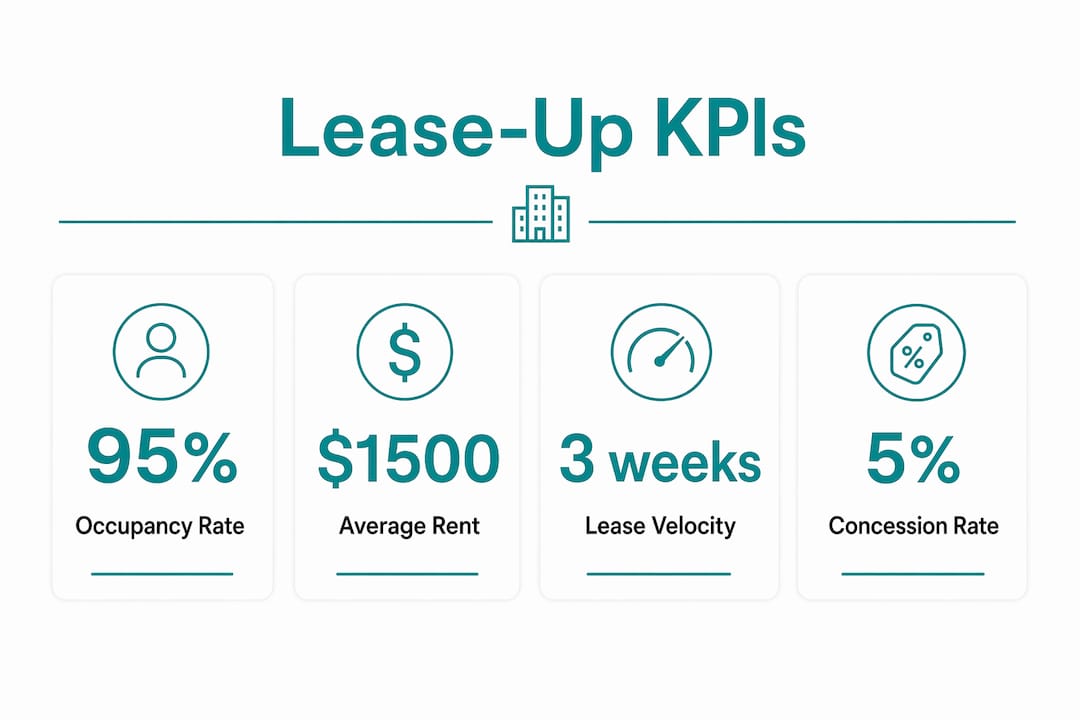
The critical KPIs to track during lease-up include:
Lead traffic: volume and source quality, not just raw count
Tour-to-lease conversion: a drop here signals pricing or product positioning problems
Move-in velocity: the pace at which signed leases convert to occupied units
Collections status: early payment issues predict future bad debt and covenant stress
Gross rent and net effective rent: the gap between these two reveals concession exposure
Rent commencement dates: when rent actually starts, not when leases are signed
Pro Tip: Review the Monday morning report before the weekly call. Identify the two or three items that need discussion and focus only on those. Going through every line item wastes time and pulls the onsite team away from leasing.
Focused KPI reviews drive faster decisions. When you know which metrics need intervention, you can coach the team on those specific issues rather than running through a full data dump that leaves everyone overwhelmed and nothing resolved.
How asset managers connect ownership and property management during lease-up
Asset managers serve as the essential bridge between ownership and the onsite property management team. Ownership sets the investment thesis. The onsite team executes daily operations. Without a clear connection between those two layers, the business plan drifts.
Communication best practices that hold this structure together:
Weekly calls with the property manager, leasing agent, and construction manager when capital work is active
Structured reporting that ties operational activity to financial milestones
Clear escalation paths when performance falls below plan
Regular recalibration of expectations when market conditions shift
One of the most underappreciated challenges in this role is inheriting a business plan you did not write. If the original underwriting assumed aggressive rent growth and the market softens, the asset manager carries that gap. The answer is not to defend the original projections. Asset managers must promptly re-underwrite and reset expectations based on current market realities. Protecting investor capital means being honest about where the plan stands, not where it was supposed to be.
For practical guidance on reading occupancy and leased trend data accurately, shadow market dynamics are worth understanding before your next ownership call.

Why early underwriting and covenant structuring reduce lease-up risk
Lease-up risk is often priced too late. Once the building is open and the clock is running, renegotiating covenant terms with lenders becomes far harder. The time to structure financial protections is before construction completes, not after the first month of leasing misses plan.
Early underwriting priorities for asset managers:
Underwrite rent commencement and net effective rent, not just gross rent or physical occupancy
Link the lease-up schedule to debt service dates and covenant testing windows
Size reserves against a slower absorption scenario, not just the base case
Structure covenants around cash flow milestones rather than promotional occupancy figures
Monitor concessions and collections as leading indicators of covenant stress
A project can reach operating breakeven on paper while still failing lender covenants if debt service begins before concessions expire. That timing mismatch is one of the most common and preventable sources of lease-up financial risk. Finance teams should structure covenants around cash rather than occupancy percentages, because occupancy can look healthy while actual cash generation lags significantly behind.
For a deeper look at how lease expiration management connects to cash flow timing, ExpirationIQ tracks lease expiration patterns across your portfolio.
Common challenges in lease-up risk management and how to address them
The most common challenges asset managers face during lease-up are structural, not operational. They stem from misaligned incentives, inherited assumptions, and the pressure to show progress before the numbers actually support it.
Frequent obstacles and practical responses:
Aggressive inherited business plans: Re-underwrite immediately. Do not wait for a quarter of missed targets to justify the conversation with ownership.
Market shifts mid-lease-up: Adjust pricing posture and concession strategy based on current submarket absorption, not the original pro forma.
Data overload: Enforce focused weekly reporting on a few critical KPIs. More data does not produce better decisions when no one has time to act on it.
Stakeholder misalignment: Sponsors want to show occupancy. Lenders protect collateral. Managers may be paid on collected revenue. Asset managers must price that friction early before it shows up in a quarterly report.
Over-managing onsite teams: Holding unnecessary meetings and micromanaging daily activity reduces efficiency and frustrates staff. Weekly structured calls outperform daily check-ins.
Understanding how property investment risk compounds across the capital stack helps asset managers frame these challenges for ownership in terms lenders and investors actually respond to.
How lease-up risk asset managers affect investment performance and value creation
The lease-up period is where the development thesis either proves out in cash or quietly misses. Asset managers who stay ahead of the metrics protect the asset’s exit value, refinance eligibility, and investor returns. Those who react late inherit compounding problems: extended concession periods, covenant pressure, and a leasing team that has lost confidence in the plan.
Active oversight during lease-up directly affects net operating income at stabilization, which drives cap rate valuation and permanent debt sizing. A property that reaches stabilized occupancy two months earlier than projected generates meaningfully more cash before the permanent loan closes. Asset managers who protect investor capital through early identification of operational problems create real value, not just on paper but in the final exit.
The best practices for leasing with revenue management reinforce this point: pricing integrity and operational discipline during lease-up set the baseline for everything that follows at stabilization.
What successful lease-up risk management looks like in practice
Consider a 300-unit new construction community in a Sunbelt submarket that opened into competing supply. The original underwriting assumed 25 move-ins per month. By week six, the property was averaging 14. An asset manager who reviewed the Monday morning report weekly caught the conversion rate drop early, identified that the tour-to-lease gap was widening, and worked with the onsite team to adjust pricing posture and concession structure before the lender’s first covenant test date.
The result was not a dramatic turnaround. It was a controlled recalibration: concessions were extended by six weeks, pricing was adjusted on slower-moving floor plans, and the leasing team received focused coaching on objection handling. The property hit its covenant threshold one month late rather than missing it entirely.
That kind of outcome does not happen by accident. It happens because someone was reviewing the right metrics at the right frequency and had the authority to act. Asset managers who wait for monthly financials to flag problems are always behind the curve.
Tools and technologies that support lease-up risk monitoring
Asset managers use a combination of operational reporting tools, revenue management platforms, and financial tracking systems to stay current on lease-up performance. The technology matters less than the discipline around it.
Practical tools in active use across the industry:
Weekly leasing reports: Move-ins, move-outs, traffic, signed leases, and collections in one structured document reviewed before every team call
Revenue management platforms: Used to monitor pricing recommendations, concession levels, and new lease performance against plan. Asset managers certified across multiple platforms can evaluate whether the system’s output reflects actual market conditions.
CRM and leasing software: Tracks lead source, tour volume, and application pipeline to identify conversion bottlenecks early
Financial modeling tools: Monthly cash flow models that link lease-up schedules to debt service dates and covenant testing windows
Lease expiration tracking: Monitoring renewal exposure and upcoming expirations prevents the occupancy cliff that can follow a strong lease-up
The Revenue Method’s apartment revenue management setup guide covers how to configure these tools for lease-up conditions specifically, including how to set pricing guardrails that reflect the asset’s actual absorption pace rather than a stabilized-property template.
Software is a tool. The strategy, the review cadence, and the human judgment behind the numbers are what make it work.
The Revenue Method brings lease-up advisory expertise to your asset

Lease-up is the highest-risk phase of any multifamily investment, and most revenue management advisory firms are not built for it. The Revenue Method is. As an independent advisory firm, The Revenue Method provides lease-up strategy, weekly review support, pricing guidance, and financial oversight without being tied to any software vendor. That independence means the advice reflects your asset’s actual conditions, not a platform’s default settings.
Whether you are heading into a new construction lease-up, inheriting a property that is behind plan, or trying to tighten your review cadence before the next covenant test, The Revenue Method works directly with owners, operators, and asset managers to build the operational structure that protects returns. Certified across six revenue management platforms and grounded in real multifamily experience, this is advisory work that starts at the business plan level and stays with you through stabilization.
Start the conversation about your lease-up strategy today.
Key Takeaways
Lease-up risk asset managers protect investor capital by maintaining a disciplined weekly review cadence, structuring covenants around cash flow, and recalibrating business plans before problems compound.
Point | Details |
Weekly cadence drives results | Review the Monday morning report before every call and focus discussion on 2–3 KPIs needing intervention. |
Cash flow covenants over occupancy | Structure lender covenants around rent commencement and net effective rent, not promotional occupancy figures. |
Re-underwrite inherited plans | When market conditions shift, reset projections immediately rather than defending the original pro forma. |
Early risk pricing matters | Execution risk becomes much harder to negotiate once the building is open and the clock is running. |
The Revenue Method | Provides independent lease-up strategy and weekly advisory support for multifamily owners and asset managers. |
Recommended

Comments